
Algorand Foundation Launches Ecosystem Advisory Council to Formalize Community Governance
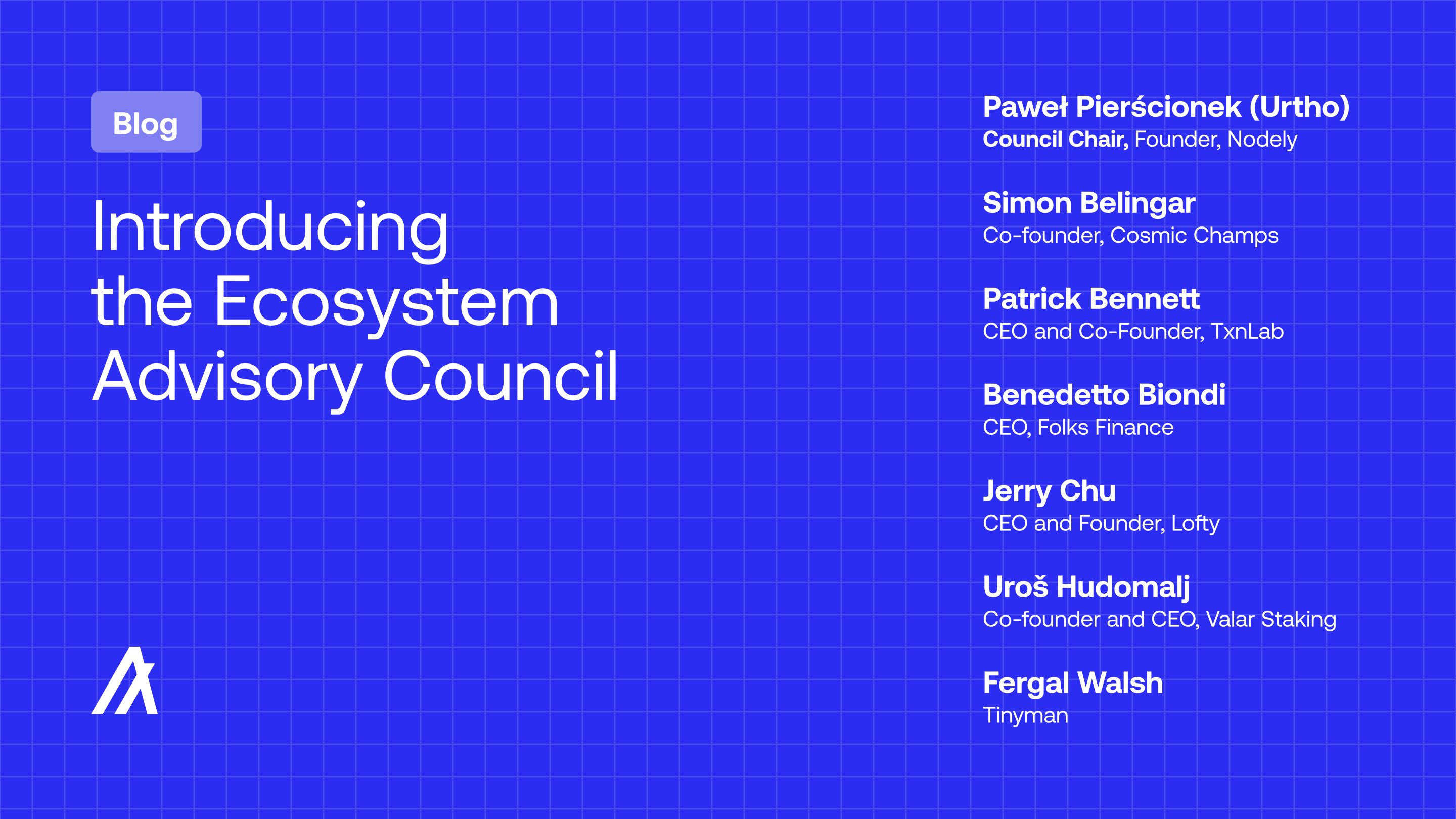
The Algorand Foundation has established a new Ecosystem Advisory Council (EAC) designed to formalize communication between the blockchain's diverse stakeholders and its leadership, marking a significant step in the network's governance evolution.
Announced on January 14, 2026, alongside the Foundation's relocation to the United States and the seating of a new Board of Directors, the EAC creates a structured channel for ecosystem participants to influence protocol direction and strategic priorities.
A Structured Bridge Between Ecosystem and Leadership
The EAC is explicitly designed to function as a "structured, productive forum" that strengthens communication between the Algorand ecosystem — developers, projects, stakers, and community members — and the Foundation's leadership, including its Board of Directors. Its core purpose is to ensure that perspectives from across the ecosystem are heard, synthesized, and reflected in ongoing decision-making.
In simpler terms, the Council acts as an institutionalized feedback loop. Rather than relying on informal Discord chats or scattered forum posts, the Foundation now has a defined body tasked with collecting, debating, and delivering the ecosystem's collective view on critical matters.
Mandate
The Council's mandate rests on three pillars. First, it will assess and represent ecosystem health by delivering written assessments of the network's overall condition, needs, and emerging opportunities directly to the Foundation Board at least annually, and more frequently as needed.
Second, it will provide substantive input on protocol decisions: the Foundation will bring key proposals — covering areas such as governance mechanics and long-term sustainability — to the EAC before presenting them to the wider community for review.
Third, the EAC will create a forum for gathering feedback from across the ecosystem in a balanced, broadly representative manner, relaying relevant needs, concerns, and sentiments to Foundation leadership.
Put plainly, the EAC gets an early look at major protocol changes, writes report cards on the ecosystem's vitality, and serves as the community's designated voice in the boardroom.
Nine Seats, Three Constituencies
To ensure diverse representation, the EAC comprises nine seats allocated across four distinct roles. Three Community Representatives are drawn from the top vote-getters in the 2025 xGov council election — Algorand's experimental governance mechanism where Algo holders vote on proposals and council members. Following an initial six-month term, future Community Representatives will be elected through a general governance vote.
Three Ecosystem Project Representatives represent the leaders of the three largest projects on the network ranked by Total Value Locked (TVL). TVL measures the total capital deposited in a project's smart contracts, serving as a proxy for user trust and adoption.
Two Principal Staker Representatives will represent the interests of major stakers — entities or individuals who lock up significant amounts of Algo to secure the network and earn rewards. Finally, a dedicated Chairperson facilitates communication between the EAC and the Foundation Board.
This design balances grassroots community voice with the operational weight of successful applications and the economic weight of network validators.
Inaugural Council
The inaugural roster reflects this balance. Community Representatives are Simon Belingar (Cosmic Champs), Patrick Bennett (TxnLab), and Uroš Hudomalj (Valar Solutions) — the top three vote recipients from the 2025 xGov council election.
Ecosystem Project Representatives are Jerry Chu (Lofty), Benedetto Biondi (Folks Finance), and Fergal Walsh (Tinyman), leading projects spanning real-world asset tokenization, decentralized lending, and automated market-making respectively. The Principal Staker Representatives are yet to be determined.
The Chairperson is Paweł Pierścionek (Urtho) from Nodely, who will also serve as technical advisor to the Board.
Strategic Context
The EAC's formation does not exist in isolation. It was announced alongside two other major organizational shifts: the Foundation's relocation to the United States and the seating of a new Board of Directors. Together, these moves signal a deliberate effort to professionalize governance, align with U.S. regulatory frameworks, and build institutional credibility as the network pursues real-world adoption.
The Foundation's 2025 roadmap emphasizes "building for real-world use," and the EAC is positioned as a key instrument for ensuring that the ecosystem's practical needs — from developer tooling to regulatory navigation — inform that roadmap.
Next Steps and the Path Ahead
The EAC will hold its first meeting before the end of Q1 2026 and will convene virtually with Foundation leadership at least twice per year. Its early agenda will likely include reviewing the 2025 roadmap's progress, assessing ecosystem health metrics, and providing input on upcoming governance and sustainability proposals.
The Council's effectiveness will ultimately be measured not by the frequency of its meetings but by whether its feedback visibly shapes Foundation decisions and whether the broader community perceives it as a legitimate voice. For a blockchain network navigating the transition from protocol launch to mature infrastructure, that legitimacy is the most critical metric of all.
Was this clear?
library_booksSource
Algorand
6 Nov 2026
- funding model
- commercial / venture capital / token-based
- jurisdiction
- International
- owner
- Private blockchain/crypto company (Algorand)
Was the source link correct?
topicRelated Articles

Congress MP Asserts Opposition Unity Against Delimitation Bill, Citing Constitutional Defense

Love as Resistance: Dalit-Feminist Anthology Reframes Intimacy as Political Defiance Against Caste

Rajasthan SOG Busts Interstate Racket Selling Forged Medical Degrees; Class 11 Dropout Posed as Doctor at Safdarjung

Four Killed in Rohtak Hotel Shooting; Police Investigate Alleged Honey-Trap Ambush

Delimitation Bill Framed as Trojan Horse to Reshape India's Electoral Map

Vijay's TVK Labels Stalin 'Savarkar 2.0' in Sharp Delimitation Offensive

Rohit Sharma Reveals Reluctance Behind Mumbai Indians Captaincy Return
