
Black Holes Could Theoretically Split Like a Pair of Pants, Study Finds
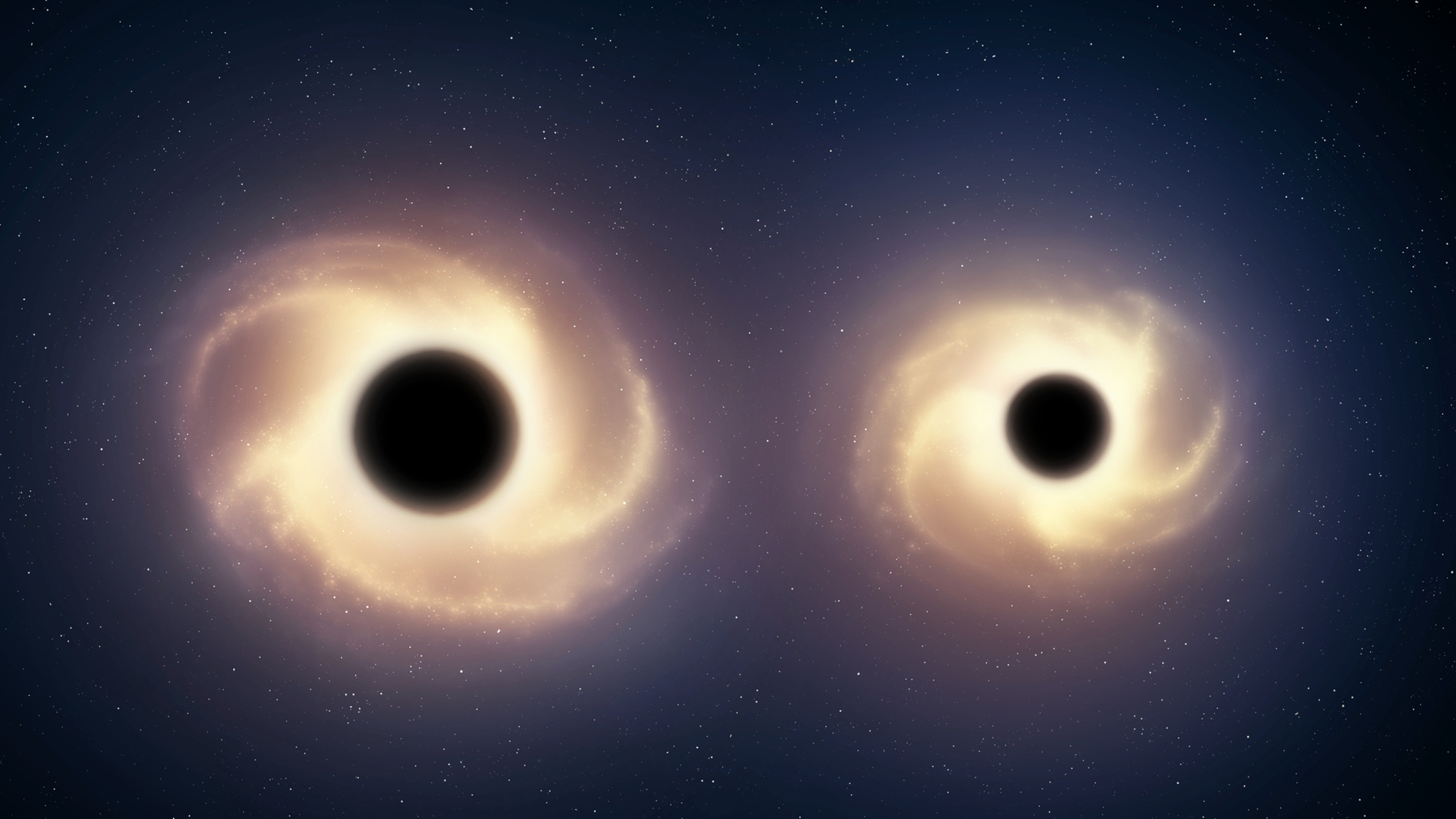
A new theoretical study suggests that black holes — long thought to only grow through mergers — could under extreme conditions fragment into multiple smaller black holes, a process the researchers describe using a "pair-of-pants" topology.
Published in Physical Review D, the work by physicists at the University of Southern Denmark maps out the precise mathematical circumstances under which a black hole's event horizon might split, revealing that while forbidden in standard four-dimensional general relativity, fragmentation becomes possible in near-extremal spinning black holes, higher-dimensional space-times, and certain modified gravity scenarios.
The findings could have implications for detecting primordial black holes and understanding exotic gravitational physics.
The "Pair-of-Pants" Topology
The research team — Giacomo Cacciapaglia, Manuel Del Piano, Francesco Sannino, and Vincenzo Vellucci — employed multiple mathematical modeling approaches to explore whether a black hole's event horizon, the boundary beyond which nothing can escape, could bifurcate.
They simplified the dynamic fragmentation process by comparing discrete slices of space-time, effectively creating static snapshots before and after a hypothetical split. The resulting topology resembles a pair of pants: a single waist (the original black hole) dividing into two legs (the fragments).
Explain it simply: Imagine a pair of pants laid flat. The waist is one opening; the two legs are separate openings. In this analogy, a single black hole splits into two distinct black holes, with the event horizon stretching and dividing like fabric tearing down the middle.
Why Splitting Is Forbidden in Our Universe
In classical four-dimensional general relativity — Einstein's description of gravity in our observable universe — two fundamental barriers prevent black hole fragmentation.
The first is entropy, governed by the second law of thermodynamics. Stephen Hawking theorized, and gravitational wave observations have since supported, that a black hole's surface area cannot decrease. Splitting a static Schwarzschild black hole (the simplest, non-rotating type) would reduce total surface area, violating this law.
The second barrier is kinematics. Even if a split could momentarily occur, the resulting fragments would be gravitationally bound and would recombine into a single black hole almost instantly.
The Loophole
The researchers identified a critical exception. A black hole rotating at nearly the maximum rate allowed by general relativity — a near-extremal black hole — could theoretically spin itself apart. At this limit, the equator of the event horizon is dragged around at nearly the speed of light. The resulting centrifugal effect could fling the two fragments apart fast enough to escape mutual recombination.
"This is why, in four-dimensional general relativity, an isolated black hole in empty space could only split if it spins very close to the maximum rate the theory allows," Del Piano explained. Under conventional space-time conditions, the conclusion is clear: black holes do not wear pants.
Higher Dimensions Change the Rules
When the team modeled black holes in space-times with more than four dimensions, the constraints loosened dramatically. In higher dimensions, gravity weakens more rapidly with distance, removing the upper limit on rotational velocity. Ultrafast-spinning black holes in these models could theoretically fragment without the near-extremal fine-tuning required in four dimensions.
In the "black string" model, a spherical black hole stretches into a cylinder across extra dimensions. This string-like object can then pinch off — similar to how a stream of water breaks into droplets — fragmenting into multiple smaller black holes, described as "beads on a string."
Modified Gravity and Bumpy Horizons
The researchers also examined scenarios where gravity behaves differently in extremely warped regions near a black hole. In certain modified gravity frameworks, fragmentation becomes entropically favored — the total entropy of the fragments exceeds that of the original black hole, satisfying the second law of thermodynamics.
Another pathway involves a "bumpy horizon": a dense shroud of exotic matter with superfluid qualities surrounding the black hole. Quantum vortices in this matter could destabilize the horizon and trigger fragmentation into multiple bodies.
Fragments Would Be Microscopic but Massive
The scale of these hypothetical fragments is staggering. Heavier parent black holes yield even smaller fragments.
Primordial Black Holes
The team expects smaller black holes to be far more prone to splitting than supermassive ones. Primordial black holes — hypothesized to have formed from density fluctuations in the early universe, moments after the Big Bang — are the prime candidates. These could range from asteroid-mass to thousands of solar masses, but the smaller end of that spectrum would be most susceptible to fragmentation.
Observational Prospects and Caveats
Gamma-ray telescopes and gravitational wave observatories might someday detect signals from a fragmenting primordial black hole — a sudden decrease in mass, a burst of radiation, or a distinctive gravitational wave signature. However, the specifics remain uncertain, and detection would depend on the dimensionality of space-time and whether the event intersects our observable "brane."
Del Piano emphasized a crucial caveat: "Our analysis shows when splitting is allowed by entropy and conservation laws, not that it actually happens. A shattered glass has more entropy than an intact one, yet glasses don't shatter on their own. Settling the question requires full dynamical simulations, which is the natural next step."
Next Steps
The current work establishes the thermodynamic and kinematic boundaries — what is forbidden, what is merely unlikely, and what becomes possible when assumptions are relaxed. The next phase demands full numerical relativity simulations that model the actual dynamical evolution of a splitting horizon, including gravitational wave emission and the fate of the fragments.
Only then can physicists determine whether the pair-of-pants topology is a mathematical curiosity or a physical reality waiting to be observed.
Was this clear?
library_booksSource
Live Science
22 Nov 2026
- funding model
- commercial media
- owner
- Future plc
Was the source link correct?
topicRelated Articles

Congress MP Asserts Opposition Unity Against Delimitation Bill, Citing Constitutional Defense

Love as Resistance: Dalit-Feminist Anthology Reframes Intimacy as Political Defiance Against Caste

Rajasthan SOG Busts Interstate Racket Selling Forged Medical Degrees; Class 11 Dropout Posed as Doctor at Safdarjung

Four Killed in Rohtak Hotel Shooting; Police Investigate Alleged Honey-Trap Ambush

Delimitation Bill Framed as Trojan Horse to Reshape India's Electoral Map

Vijay's TVK Labels Stalin 'Savarkar 2.0' in Sharp Delimitation Offensive

H5N1 Avian Influenza Spreads to Coimbatore Wild Birds as Tamil Nadu Intensifies Poultry Culling in Cuddalore
