
Viral Video of Bangladesh Arson Attack Debunked: Fact-Check Reveals Political, Not Communal, Motive
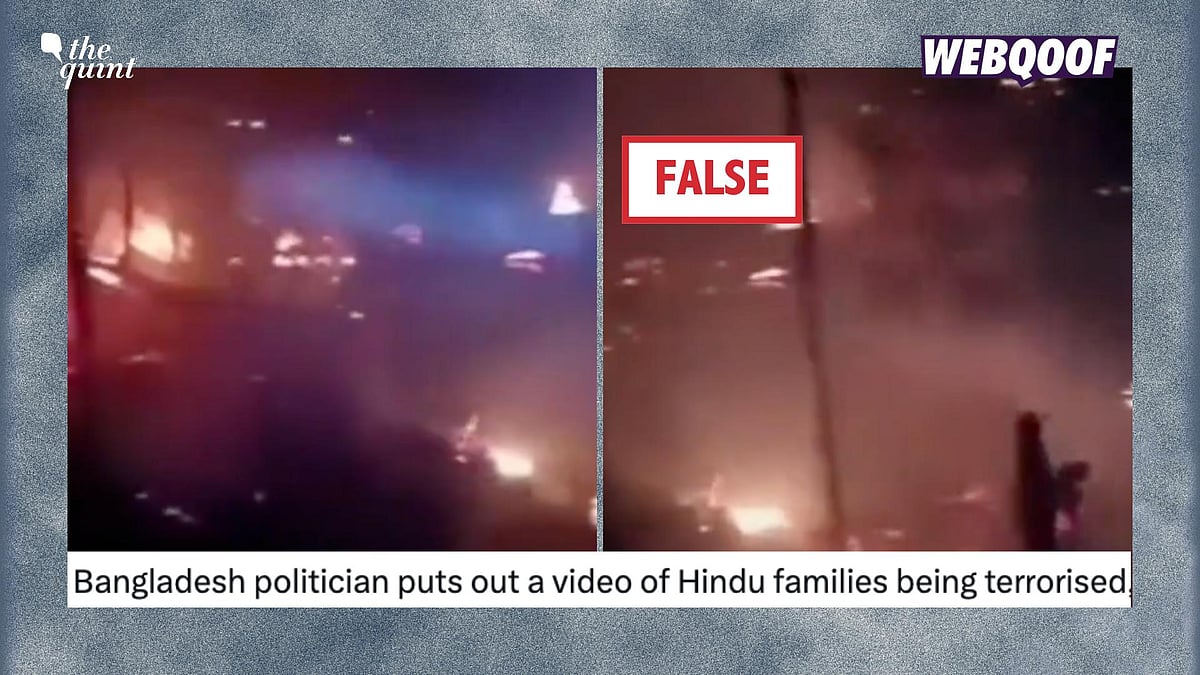
A widely circulated video showing dozens of homes ablaze in Bangladesh's Narail district has been conclusively proven to depict a politically motivated attack rather than the anti-Hindu communal violence claimed across social media platforms.
The fact-check, conducted by The Quint's WebQoof unit, dismantles a narrative amplified by prominent Indian media figures that framed the November 2026 incident in Kalia upazila as a targeted assault on the Hindu minority.
Multiple independent sources — including local police, administration officials, Bangladeshi news outlets, and on-ground reporters — confirm the arson targeted Awami League affiliates following the killing of two Bangladesh Nationalist Party (BNP) leaders, with no Hindu households affected.
The Viral Claim and Its Amplification
The video, filmed in Bendarchar village, shows a massive fire consuming residential structures. Within hours, it was shared with captions alleging a pogrom against Hindus.
Among the most influential amplifiers was Rahul Shivshankar, Editorial Affairs Director at CNN News18, who posted on X (formerly Twitter) that "BANGLADESH CANNOT BECOME A HUNTING GROUND FOR HINDUS!" The post garnered significant engagement, embedding the communal narrative into the information ecosystem before verification could catch up.
This pattern — where emotionally charged visuals outpace contextual reporting — is a hallmark of modern misinformation campaigns, particularly in politically volatile regions.
How the Fact-Check Uncovered the Truth
The investigation began with a simple keyword search: "Kalia houses on fire." This led to a DD News report carrying near-identical visuals, which explicitly described the vandalism as targeting Awami League members after two BNP leaders were killed. The trail quickly expanded.
Prothom Alo, Bangladesh's leading daily, reported from Bendarchar that 10-12 houses were torched by an "angry mob" but noted zero casualties and, crucially, no mention of religious targeting. The Upazila Executive Officer, Jinnatul Islam, confirmed to Prothom Alo that the burnt properties belonged to former Awami League leader BM Kabirul Haque and General Secretary Krishnapada Ghosh.
The Kalia Police Station Officer-in-Charge, Idris Ali, told BBC Bangla the same: the attack was retaliation by a mob, not a communal operation. Bangladesh Sangbad Sanstha (BSS), the state news agency, carried an official police statement categorically denying any communal angle and warning against the false narrative on social media.
Independent Bangladeshi fact-checker Shohanur Rahman also publicly labeled the communal claim false.
The Methodology
The fact-check exemplifies a core principle of verification: triangulation. Rather than relying on a single source, the investigators cross-referenced state media (DD News, BSS), independent Bangladeshi journalism (Prothom Alo, BBC Bangla), local administration, police, and an independent fact-checker. Each source independently converged on the same conclusion — political retaliation.
This multi-source convergence is the gold standard in open-source intelligence (OSINT), where the reliability of a claim increases exponentially with each independent corroboration. In plain terms: when the police, the local government, the village reporters, and an independent fact-checker all tell the same story, the alternative narrative collapses.
What Actually Happened in Narail
The sequence of events reconstructs a classic cycle of political violence in Bangladesh's polarized landscape. Two BNP leaders were killed — the trigger. In response, a mob attacked the homes of their perceived political rivals, who happened to be Awami League functionaries. The victims' religious identity was incidental; their political affiliation was the target.
Prothom Alo's ground report emphasizes that residents, police, and administration all confirmed no Hindu homes were touched. This distinction is critical: in a region where communal and political lines often blur, the fact-check establishes that the motive was partisan retribution, not religious hatred.
The Architecture of a Communal Narrative
Why did the communal claim gain traction? Three factors align. First, visual evidence of burning homes is visceral and shareable, bypassing critical scrutiny. Second, the India-Bangladesh context is primed for communal narratives; incidents of minority persecution in Bangladesh receive intense coverage in India, creating a receptive audience for such claims.
Third, influential voices with large followings — like Shivshankar — act as super-spreaders, lending institutional credibility to unverified claims. The fact-check notes that archives of similar posts exist, suggesting a coordinated or at least convergent effort to frame the incident.
This mirrors global patterns where political violence is rebranded as religious persecution to serve domestic or international agendas.
Verification in the Age of Algorithmic Amplification
The Kalia case underscores a structural asymmetry: misinformation spreads at the speed of a retweet; verification moves at the speed of shoe-leather reporting. By the time the WebQoof report was published, the communal narrative had already achieved virality. Platforms amplify content that triggers high-arousal emotions — outrage, fear, moral indignation — regardless of truth value.
Fact-checks, by contrast, are nuanced, text-heavy, and rarely achieve comparable reach. This dynamic erodes public trust and hardens false perceptions. The solution is not merely more fact-checks but systemic changes: algorithmic downranking of unverified viral claims, prominent correction labels on debunked posts, and media literacy that teaches users to pause before sharing incendiary content.
A Cautionary Template for Future Incidents
The Narail fire will not be the last incident weaponized as communal violence. The fact-check provides a replicable template: geolocate the visuals, search local language sources, contact ground-level authorities, and seek convergence across institutional, journalistic, and independent voices.
For newsrooms, the lesson is editorial restraint — the cost of amplifying a false communal claim is measured in damaged inter-community relations and delegitimized journalism. For the public, the lesson is skepticism toward narratives that perfectly fit pre-existing ideological templates.
In a region where a single viral video can inflame tensions across borders, rigorous verification is not just journalistic best practice — it is a civic necessity.
Was this clear?
library_booksSource
The Quint
23 Nov 2026
- funding model
- privately held, founder-backed (revenue from advertising and subscriptions; Bahl previously founded Network18, now separately owned)
- owner
- The Quint (Quintillion Media Pvt Ltd), founded by Raghav Bahl and Ritu Kapur
Was the source link correct?
topicRelated Articles

Congress MP Asserts Opposition Unity Against Delimitation Bill, Citing Constitutional Defense

Love as Resistance: Dalit-Feminist Anthology Reframes Intimacy as Political Defiance Against Caste

Rajasthan SOG Busts Interstate Racket Selling Forged Medical Degrees; Class 11 Dropout Posed as Doctor at Safdarjung

Four Killed in Rohtak Hotel Shooting; Police Investigate Alleged Honey-Trap Ambush

Delimitation Bill Framed as Trojan Horse to Reshape India's Electoral Map

Vijay's TVK Labels Stalin 'Savarkar 2.0' in Sharp Delimitation Offensive

Rohit Sharma Reveals Reluctance Behind Mumbai Indians Captaincy Return
