
Gandhi's Final Stand: How Non-Violence Failed in the Face of Partition's Horror
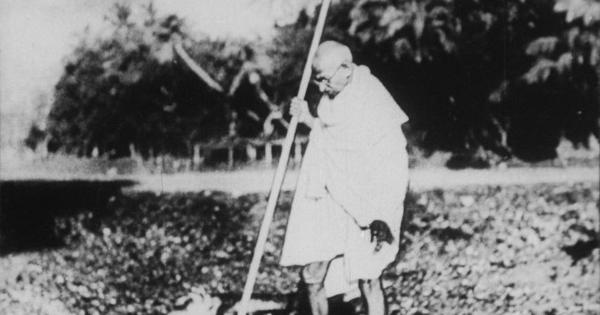
Political theorist Manash Firaq Bhattacharjee's new book, Gandhi: The End of Non-Violence, argues that the Mahatma's 1946–47 peace mission in Noakhali and Bihar represents both the most heroic chapter of his life and the definitive collapse of his guiding philosophy.
Drawing on a close reading of Gandhi's final months, Bhattacharjee contends that historians have sanitised the moral horror of Partition, reducing a civilisational rupture to mere causal politics.
The work reframes Gandhi not as the confident architect of 1930, but as a haunted figure confronting the empirical failure of non-violence against a violence that had become, in Gandhi's own admission, 'the truth'.
The Forgotten Chapter
Despite endorsements from figures as ideologically distant as Marxist historian Sumit Sarkar, Salman Rushdie, and V.S. Naipaul — who variously called Noakhali Gandhi's "finest hour," a "long, pacifying walk," and "magnificent" — the episode remains conspicuously absent from mainstream scholarship and, strikingly, from curricula in Bengal itself. Bhattacharjee identifies this as a "quiet act of academic neglect and censorship" by successive political regimes and their intellectual allies.
In simple terms: The most celebrated chapter of Gandhi's life by his toughest critics is the one least studied in Indian universities, particularly in the region where it happened.
The Gandhi Bhattacharjee reconstructs is pursued by failure. The social fabric in Bengal, Bihar, and Punjab had disintegrated with terrifying speed after the Muslim League's push for Pakistan. Gandhi walked alone into this abyss, covering villages where neighbourhoods had turned into war zones divided by religion.
Ethics Over Institutions
A central tension in the book is Gandhi's deliberate operation outside the state apparatus. He refused police protection, declined to frame justice through legal processes, and instead made ethical demands on both victims and perpetrators.
Bhattacharjee explains this not as naivety but as a strategic recognition: the interim governments in Bengal and Bihar were complicit in orchestrating the violence. Institutional power was a prerequisite for the scale of the killings; therefore, the state machinery was "morally and procedurally compromised."
In simple terms: Gandhi knew the government was part of the problem, so he couldn't ask the government to be the solution. He tried to rebuild morality between neighbours instead.
In May 1947, Gandhi told Bengal's Chief Minister Huseyn Suhrawardy he was responsible for every Hindu and Muslim death in the province. In Bihar, he publicly acknowledged Congressmen's participation in disturbances.
When state complicity is total, Bhattacharjee argues, Gandhi placed faith in an "interpersonal ethic of justice." He offered perpetrators a private tribunal — confession without police handover — not as religious ritual but as a psychological mechanism to verify that guilt existed and social morality was recoverable. The legal order punishes crime; it cannot restore civic morality.
Prayer Meetings as Mass Therapy in a Landscape of Death
Bhattacharjee reads Gandhi's prayer meetings through Freud's Civilization and Its Discontents and Simone Weil's concept of attentiveness as miracle. These were "public events of mass therapy conducted within hostile spaces where the memory of human cruelty was still hot and throbbing." Gandhi introduced spiritual music, including Rabindrasangeet, listened to victim accounts, and responded to them — attempting a language of healing where grief was too raw for conventional politics.
In simple terms: Gandhi treated prayer meetings like group therapy sessions for a traumatised society, using music and listening to help people process unspeakable horror.
The Failure of Non-Violence
Gandhi repeatedly admitted failure in Noakhali. The violence — severed heads, ripped bellies, wells filled with women and children — overwhelmed his experiment in moral restraint. Bhattacharjee stresses that this admission came from "a deep sense of political and moral responsibility," the exact opposite of the political culture of blame-shifting. Gandhi refused to save non-violence from the scrutiny of truth. Violence did not merely announce itself as truth; it was the truth in that moment.
In simple terms: Gandhi honestly admitted his life's philosophy had failed to stop the slaughter, refusing to make excuses or rewrite history.
Bhattacharjee situates this within an epic framework: Gandhi saw the nationalist-colonial conflict as a civilisational drama. The failure was also structural — the Muslim League's rise, aided by colonial interests, and the communal-separatist school's dominance in the 1940s ensured Gandhi's political marginalisation before the final act.
Critiquing Partition Historiography
Bhattacharjee's sharpest polemic targets Indian historians of Partition violence — Joya Chatterji, Partha Chatterjee, Janam Mukherjee — whom he accuses of offering "political analysis as food for thought" while shrinking from the moral and ethical dimensions. He contrasts them with Holocaust writers like Primo Levi, Hannah Arendt, and W.G. Sebald, who explored how racist nationalism produces total moral collapse.
In simple terms: Scholars explain why Partition happened (class, elite politics, famine memory) but avoid asking what the violence means for human nature and civilisation.
Chatterji blames nationalist politics while omitting the British role and reduces death tolls to sociological detail. Chatterjee attributes violence to "elite politics" converting class into community. These "ideologically motivated remarks" treat humans as theoretical subjects, missing the "deeper story, the common language, of human life."
The Danger of Ideological Blindness
The book warns that ideological critiques of violence often mirror the violence they condemn. Nazi ideology matters less than what that ideology didn't allow them to consider. Liberal, communist, or religious nationalist critiques have not prevented their adherents from replicating barbarism. "Every ideology secretly borrows, mirrors, and executes the violence of its opponents and justifies it against them."
In simple terms: All political ideologies — liberal, communist, nationalist — end up copying the brutality they claim to oppose, because ideology itself becomes a religion that blinds followers to their own cruelty.
Bhattacharjee demands a "genuinely philosophical rumination" that abandons both communal lenses and the "banality of a neutral gaze." It requires mourning brutality without selective outrage, feeling the pain of both sides as Gandhi did, and asking what such events mean for modernity, Marxist and liberal values, and the "historical fiction of individual autonomy." Without this moral compass, he argues, we lose the only arc that bends toward justice.
A Challenge to How We Remember
Gandhi: The End of Non-Violence is less a biography than an indictment of how intellectuals process cataclysm. By centring Gandhi's failure and the moral horror he witnessed, Bhattacharjee forces a confrontation with the limits of politics, the complicity of the state, and the inadequacy of scholarship that explains away the unspeakable. The book insists that some wounds cannot be analysed — they must be faced.
Was this clear?
library_booksSource
Scroll.in
23 Nov 2026
- funding model
- independent commercial media (revenue from advertising, reader subscriptions and grants)
- owner
- Scroll.in (Scroll Media), an independent digital newsroom founded by Samir Patil
Was the source link correct?
topicRelated Articles

Congress MP Asserts Opposition Unity Against Delimitation Bill, Citing Constitutional Defense

Love as Resistance: Dalit-Feminist Anthology Reframes Intimacy as Political Defiance Against Caste

Rajasthan SOG Busts Interstate Racket Selling Forged Medical Degrees; Class 11 Dropout Posed as Doctor at Safdarjung

Four Killed in Rohtak Hotel Shooting; Police Investigate Alleged Honey-Trap Ambush

Delimitation Bill Framed as Trojan Horse to Reshape India's Electoral Map

Vijay's TVK Labels Stalin 'Savarkar 2.0' in Sharp Delimitation Offensive

Rohit Sharma Reveals Reluctance Behind Mumbai Indians Captaincy Return
