
Gemini North Captures Twin Spirals Locked in Gravitational Dance 200 Million Light-Years Away
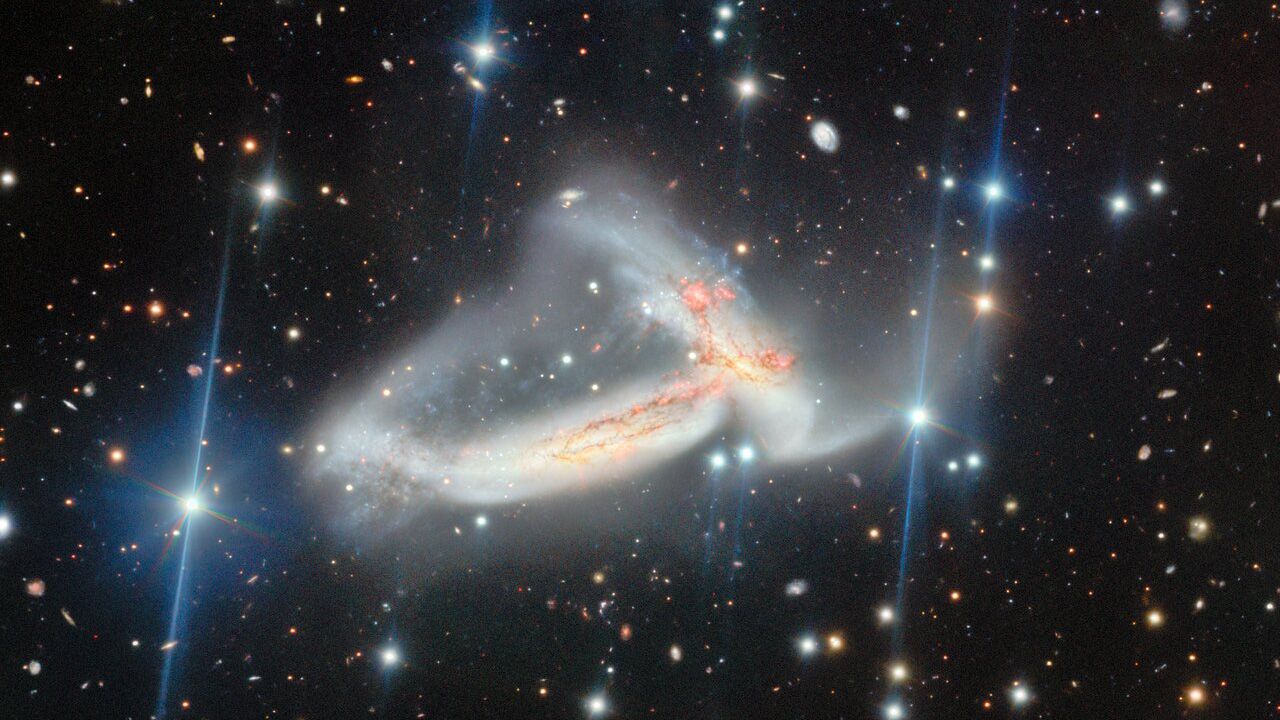
A striking new image from the Gemini North telescope atop Mauna Kea reveals NGC 7253 — a pair of spiral galaxies caught in a slow-motion gravitational embrace that is stretching their arms into tangled streams of stars, gas, and dust.
Located roughly 200 million light-years from Earth in the constellation Pegasus, the system is cataloged as Arp 278 in the Atlas of Peculiar Galaxies, a compendium of galaxies that defy the neat classifications of symmetric spirals or smooth ellipticals.
The photograph, released on September 1, 2026, showcases not only the disruptive power of gravity on galactic scales but also the creative potential of such encounters: bright pink knots scattered across the distorted disks mark regions where compressed hydrogen gas is igniting bursts of new star formation.
The Mechanics of a Galactic Encounter
When two massive galaxies pass close to one another, their mutual gravitational pull exerts tidal forces that distort each galaxy's structure. Spiral arms, which are density waves propagating through a disk of stars and gas, are particularly susceptible. As the galaxies swing past each other, these arms are pulled outward into long tidal tails and bridges, creating the chaotic, "balloon animal" appearance seen in NGC 7253.
Explain it simply: Imagine two whirlpools in a pond drifting near each other. The water in each whirlpool gets pulled toward the other, stretching the spiral patterns into elongated streams. In galaxies, the "water" is stars, gas, and dark matter, and the stretching plays out over hundreds of millions of years.
Despite the violent appearance, direct collisions between individual stars are exceedingly rare. The typical separation between stars in a galaxy is millions of times the diameter of the stars themselves. Instead, the real action occurs in the interstellar medium — the vast clouds of cold gas and dust that permeate spiral arms.
Triggering Stellar Birth
The gravitational disturbance compresses these molecular clouds, raising their density until they become gravitationally unstable and collapse. This process fuels starburst activity, visible in the Gemini image as concentrations of bright pink emission. These are H II regions — enormous clouds of ionized hydrogen gas energized by intense ultraviolet radiation from hot, massive newborn stars.
Explain it simply: H II regions are cosmic neon signs. When massive young stars form, their fierce ultraviolet light strips electrons from surrounding hydrogen atoms. When those electrons recombine with protons, they emit a characteristic pinkish-red glow, revealing where new stars are being born.
The image thus captures a dual narrative: gravity is simultaneously dismantling the ordered architecture of two spiral galaxies and assembling the raw material for future generations of stars. Over cosmic time, such interactions often culminate in a full merger, producing a single, more massive galaxy — frequently an elliptical — with a mixed population of old and newly formed stars.
A Name Rooted in Place and Partnership
The observation carries cultural significance beyond its scientific value. The system has been gifted the Hawaiian name Nā 'Uhane Māhoe Huki Pū i ke Ola, which translates to "The Twin Spirits Pulling Together Creating Life." The name was chosen by Hawaii high school students participating in the 2026 Project Hōkūlani internship program, an initiative that connects local youth with the research conducted on Mauna Kea.
The designation operates on multiple levels. "Twin spirits" evokes the two galaxies locked in their gravitational dance. It also honors the twin telescopes of the International Gemini Observatory — Gemini North on Mauna Kea and Gemini South on Cerro Pachón in Chile — which together provide full-sky coverage for the international partnership.
Finally, the name situates the object within Ka Lupe o Kawelo, the Hawaiian constellation corresponding to Pegasus, grounding a discovery made with cutting-edge instrumentation in the ancestral knowledge of the land hosting the telescope.
Context
At the time, the mechanisms behind these distortions were debated. Today, they are recognized as signposts of galaxy interactions and mergers, processes that are central to the hierarchical assembly of galaxies in the standard cosmological model.
NGC 7253 offers a relatively nearby, well-resolved laboratory for studying these processes in detail. Its proximity (by extragalactic standards) allows telescopes like Gemini North to resolve individual star-forming complexes and map the kinematics of disturbed gas, providing benchmarks for simulations of galaxy evolution.
The View from Mauna Kea
The image of NGC 7253 demonstrates the observatory's continuing role in producing science-grade data that also resonates visually with the public — a dual mandate that has become increasingly important for major research facilities.
As the gravitational dance of NGC 7253 continues over the next few hundred million years, the two spirals will likely complete their merger, their distinct identities erased in a single, larger galaxy. For now, the Gemini image freezes a fleeting moment in that transformation: two galaxies pulling each other apart, and in the process, pulling new stars into existence.
Was this clear?
library_booksSource
Live Science
22 Nov 2026
- funding model
- commercial media
- owner
- Future plc
Was the source link correct?
topicRelated Articles
Musk Pledges $18 Billion SpaceX Share Giveaway to US Children Amid Satellite Expansion Push

NASA's $1.3B Lunar Logistics Network, Fission Reactor, and Potato Breakthrough Signal Shift to Permanent Moon Base Infrastructure

NASA's Aging Mars Fleet Suffers Dual Setbacks as Perseverance and Odyssey Halt Science Operations

Congress MP Asserts Opposition Unity Against Delimitation Bill, Citing Constitutional Defense

Love as Resistance: Dalit-Feminist Anthology Reframes Intimacy as Political Defiance Against Caste

Rajasthan SOG Busts Interstate Racket Selling Forged Medical Degrees; Class 11 Dropout Posed as Doctor at Safdarjung

Four Killed in Rohtak Hotel Shooting; Police Investigate Alleged Honey-Trap Ambush
