
ICRC and African Union Deepen Partnership to Uphold Laws of War Amid Rising Conflicts
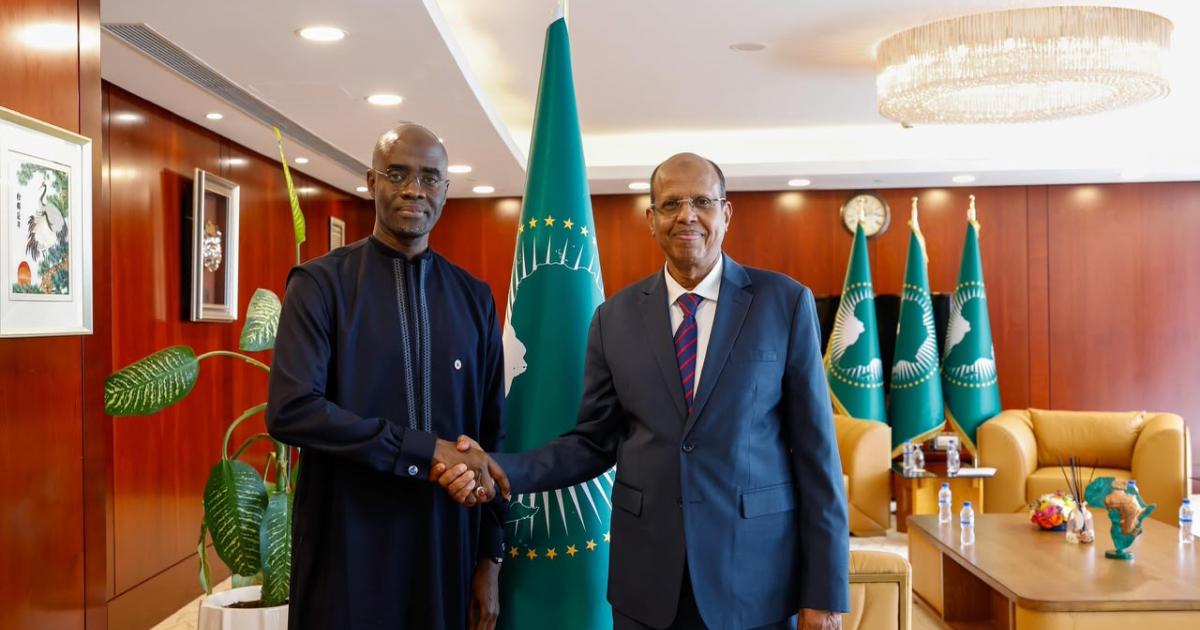
The International Committee of the Red Cross (ICRC) and the African Union (AU) have renewed their commitment to strengthen cooperation in promoting respect for international humanitarian law (IHL), as the continent grapples with escalating armed conflicts and mounting humanitarian crises.
The pledge came during a meeting in Addis Ababa on October 15, where the ICRC’s new head of delegation to the AU, Mame Ibrahima Tounkara, presented his credentials to AU Commission Chairperson Mahmoud Ali Youssouf.
International humanitarian law, often called the laws of war, is a set of rules that seek to limit the effects of armed conflict. It protects people who are not or are no longer participating in hostilities — such as civilians, wounded soldiers, and prisoners — and restricts the means and methods of warfare.
A Shared Commitment to Humanitarian Protection
Both leaders emphasized the urgent need to protect civilians, uphold the dignity of migrants, and address forced displacement. Chairperson Youssouf stressed that predictable and adequate funding, stronger international solidarity, and better coordination among humanitarian actors are essential to meet growing needs. The discussions underscored a shared vision: preserving multilateralism and reinforcing the legal frameworks that shield vulnerable populations during war.
The Global IHL Initiative
A centerpiece of the dialogue was the Global Initiative to Galvanize Political Commitment to International Humanitarian Law. Launched by the ICRC, this initiative aims to renew states’ political dedication to IHL and advocate for practical measures that better protect people affected by armed conflict. Mr.
Tounkara outlined how the initiative seeks to move beyond abstract endorsements, pushing for concrete national policies, military training, and accountability mechanisms that translate legal obligations into battlefield realities.
The initiative works by encouraging states to make specific, measurable pledges — such as updating military manuals, prosecuting war crimes domestically, or ensuring humanitarian access — and then tracking implementation through peer review and reporting.
Addressing Forced Displacement and Funding Gaps
Africa hosts over one-third of the world’s forcibly displaced people, a figure driven by protracted conflicts in the Sahel, the Horn of Africa, and the Great Lakes region. Chairperson Youssouf highlighted that humanitarian funding remains volatile, often tied to short-term donor cycles rather than the multi-year commitments needed for sustainable response.
The AU and ICRC agreed to advocate jointly for more flexible, predictable financing — including through the AU’s own humanitarian fund — and to improve coordination between UN agencies, NGOs, and local responders.
Road to the High-Level Conference in Jordan
As a tangible next step, Mr. Tounkara extended an invitation to Chairperson Youssouf to attend the High-Level Conference on Humanity in War, scheduled for December 7, 2026, in Jordan. The conference will gather heads of state, foreign ministers, and leaders of regional organizations to adopt a political declaration reaffirming commitment to IHL and announcing new national actions.
The AU’s participation is seen as critical to ensuring African perspectives — particularly on the protection of displaced persons and the conduct of non-state armed groups — shape the global agenda.
Preserving Multilateralism in a Fragmented World
Beyond immediate humanitarian concerns, the meeting reflected a broader strategic alignment. Both organizations view the erosion of respect for IHL as a symptom of weakening multilateral institutions.
By deepening their partnership, the ICRC and AU aim to demonstrate that regional bodies can play a pivotal role in upholding global norms, even when consensus at the UN Security Council proves elusive. The collaboration also includes joint efforts to advance an AU declaration on strengthening IHL implementation across the continent, building on dialogues held earlier in 2026.
As conflicts grow more complex and humanitarian needs outpace resources, the ICRC-AU alliance offers a model of how legal advocacy, operational coordination, and political diplomacy can converge. The coming months will test whether the renewed pledges translate into measurable protection for the millions caught in Africa’s wars.
Was this clear?
library_booksSource
International Committee of the Red Cross
12 Nov 2026
- funding model
- non-profit (grants, donations)
- jurisdiction
- International
- owner
- Non-governmental organization (International Committee of the Red Cross)
Was the source link correct?
topicRelated Articles

Congress MP Asserts Opposition Unity Against Delimitation Bill, Citing Constitutional Defense

Love as Resistance: Dalit-Feminist Anthology Reframes Intimacy as Political Defiance Against Caste

Rajasthan SOG Busts Interstate Racket Selling Forged Medical Degrees; Class 11 Dropout Posed as Doctor at Safdarjung

Four Killed in Rohtak Hotel Shooting; Police Investigate Alleged Honey-Trap Ambush

Delimitation Bill Framed as Trojan Horse to Reshape India's Electoral Map

Vijay's TVK Labels Stalin 'Savarkar 2.0' in Sharp Delimitation Offensive

Rohit Sharma Reveals Reluctance Behind Mumbai Indians Captaincy Return
