
ICRIER Report Charts Three Pathways to Sustainable Agriculture in Uttar Pradesh
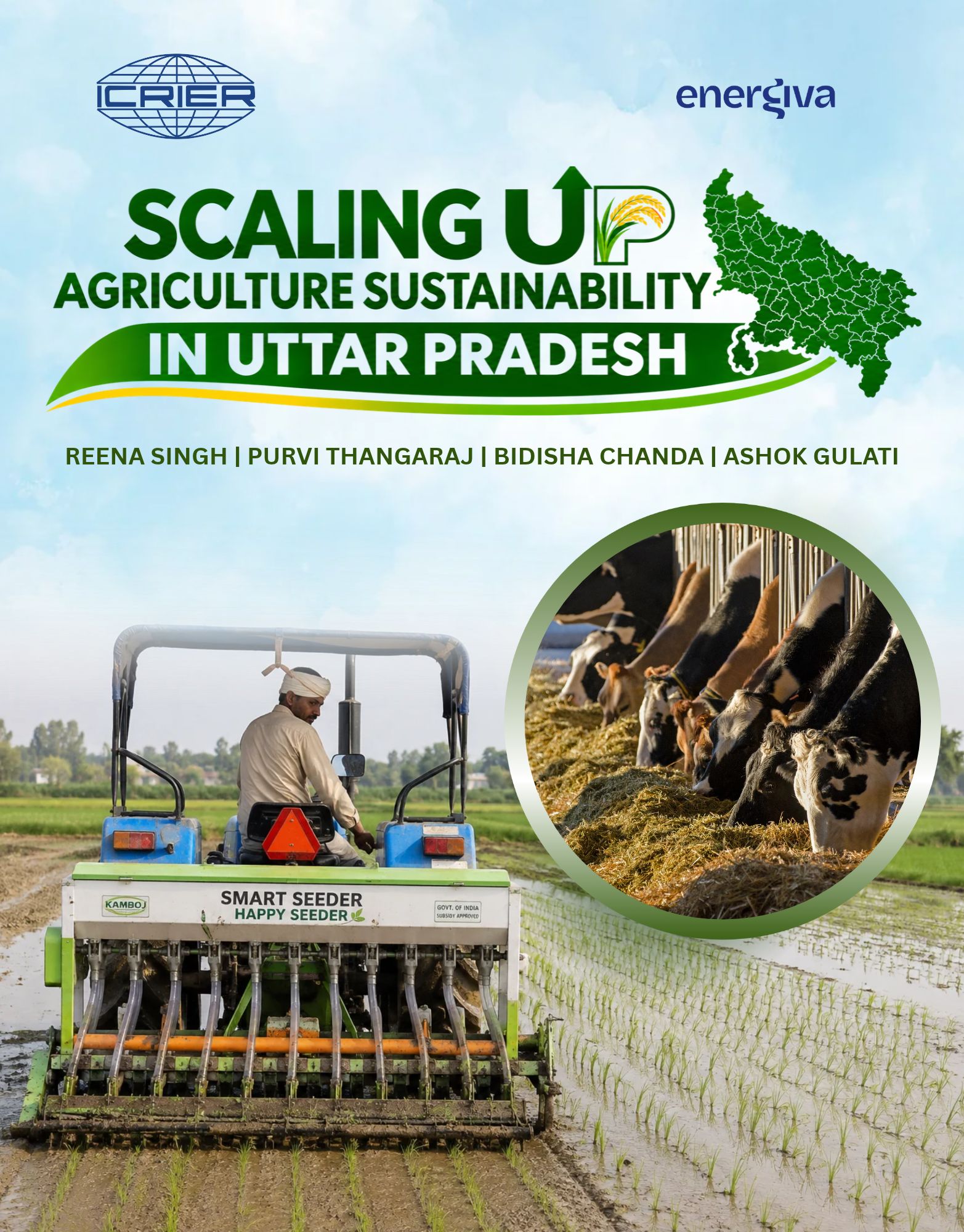
A new report from the Indian Council for Research on International Economic Relations (ICRIER) lays out a targeted strategy to transform agriculture in Uttar Pradesh, India's most populous state and a linchpin of national food security. Authored by Dr. Reena Singh, Ms. Purvi Thangaraj, Ms. Bidisha Chanda, and Dr.
Ashok Gulati, the study identifies direct-seeded rice, climate-smart dairy management, and precision fertiliser application as the three priority levers to reduce resource stress, cut emissions, and raise farmer incomes. With agriculture contributing 26 per cent of the state's gross value added and employing nearly half its workforce, the stakes extend well beyond UP's borders.
The Scale of the Challenge
Uttar Pradesh sits at the centre of India's food and nutritional security architecture. The state produces a significant share of the country's wheat, rice, sugarcane, and milk. Yet the current production model is running into hard ecological limits.
Groundwater tables are falling across large swathes of the western and central regions, driven by water-intensive cropping patterns and subsidised electricity for pumping. Agricultural greenhouse gas emissions are rising, with livestock alone accounting for more than 41 million tonnes of carbon dioxide equivalent annually.
Fertiliser use remains heavily skewed toward nitrogen, degrading soil health and polluting waterways. The report argues that incremental adjustments will not suffice; a systemic shift toward resource-efficient, climate-resilient practices is now urgent.
Pathway One
The first priority pathway focuses on rice, the state's dominant kharif crop. Conventional transplanted puddled rice requires standing water throughout much of the growing season, consuming vast quantities of irrigation water and energy for pumping. It also creates anaerobic soil conditions that generate methane, a potent greenhouse gas. Direct-seeded rice (DSR) eliminates the nursery and transplanting steps; seeds are sown directly into the field, either dry or with minimal water.
How DSR works in practice
When combined with mechanised weed control and improved varieties bred for early vigour, yields can match or exceed transplanted rice. The report stresses that scaling DSR requires a package: quality seed, appropriate herbicides, laser land levelling, and, crucially, a strong extension network to guide farmers through the transition.
Pathway Two
Livestock is UP's largest agricultural sub-sector by value, but it is also the state's biggest source of agricultural emissions. The report highlights a dual challenge: low productivity per animal and a growing population of stray cattle that damage crops and emit methane without contributing to output.
The proposed solution integrates three elements: genetic improvement and better feeding to raise milk yields, solar-powered cow shelters (gaushalas) that capture dung for biogas and compost, and a market-linked value chain for the resulting organic fertiliser and energy.
Turning waste into value
A climate-smart shelter uses solar panels to power fans, lighting, and water pumps, improving animal welfare and reducing mortality. Dung is fed into biogas digesters, producing clean cooking fuel for rural households and slurry that is composted into nutrient-rich organic fertiliser. This closes the nutrient loop, displaces synthetic fertiliser, and cuts methane emissions from open dung piles.
Linking these shelters to farmer producer organisations ensures the compost reaches fields, creating a circular economy that benefits both dairy farmers and crop growers.
Pathway Three
India's fertiliser subsidy regime has long incentivised excessive urea application, leading to a skewed nitrogen-phosphorus-potassium ratio that degrades soil structure, reduces micronutrient availability, and leaches nitrate into groundwater. The third pathway advocates a shift to soil-test-based, crop-specific nutrient management. This means moving from blanket recommendations to prescriptions tailored to each field's nutrient status and the specific crop's needs.
The mechanics of precision nutrition
Farmers collect soil samples, which are analysed for macro- and micronutrients, pH, and organic carbon. Based on the results, a digital advisory — delivered via mobile app, SMS, or village-level entrepreneur — specifies the exact fertiliser blend, dosage, and timing for the intended crop. The report underscores that the technology exists; the bottleneck is last-mile delivery.
Strengthening the network of soil testing labs, training village-level advisers, and integrating the advisories with the existing PM-KISAN and e-NAM platforms are essential steps.
Implementation Priorities and the Road Ahead
The report does not stop at identifying technologies; it maps the institutional and policy enablers needed for scale. For DSR, this includes reforming electricity pricing to reflect the true cost of groundwater extraction, ensuring timely herbicide availability, and incentivising custom hiring centres for seed drills.
For dairy, it calls for public-private partnerships to finance shelter infrastructure, streamlined biogas grid-injection policies, and quality certification for compost. For fertiliser, it recommends direct benefit transfer of subsidy based on soil-health-card prescriptions rather than volume of urea purchased.
Cross-cutting all three pathways is the need for a revitalised agricultural extension system. The authors argue for a pluralistic model that combines public Krishi Vigyan Kendras, private agri-tech platforms, farmer producer organisations, and trained village-level entrepreneurs. Digital tools — remote sensing for crop monitoring, AI-driven pest advisories, and blockchain for input traceability — can amplify reach, but they must be grounded in local context and farmer trust.
Uttar Pradesh's agricultural transition is not merely a state-level concern. The ICRIER report provides a evidence-backed, actionable framework. The test now lies in political will, inter-departmental coordination, and the capacity to deliver knowledge and finance to the last farmer in the field.
Was this clear?
library_booksSource
Indian Council for Research on International Economic Relations
21 Nov 2026
- funding model
- government funded
- jurisdiction
- India
- owner
- Government of India
Was the source link correct?
topicRelated Articles

A Decade of Escalating Food Crises Exposes Deepening Global Vulnerabilities

Congress MP Asserts Opposition Unity Against Delimitation Bill, Citing Constitutional Defense

Love as Resistance: Dalit-Feminist Anthology Reframes Intimacy as Political Defiance Against Caste

Rajasthan SOG Busts Interstate Racket Selling Forged Medical Degrees; Class 11 Dropout Posed as Doctor at Safdarjung

Four Killed in Rohtak Hotel Shooting; Police Investigate Alleged Honey-Trap Ambush

Delimitation Bill Framed as Trojan Horse to Reshape India's Electoral Map

Vijay's TVK Labels Stalin 'Savarkar 2.0' in Sharp Delimitation Offensive
