
In the Himalayas, Community Radio Bridges the Gap Between Government Alerts and Local Reality
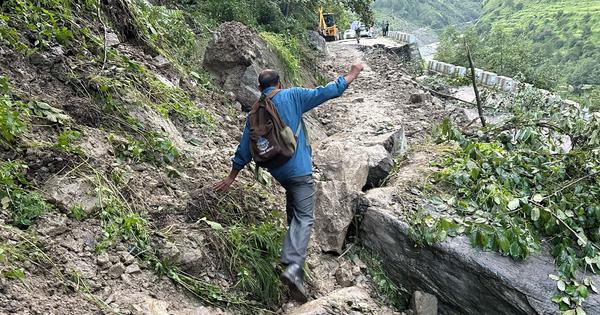
On a monsoon afternoon in Rudraprayag, the district administration declared a landslide-blocked mountain road cleared and open to traffic. Manvendra Negi read the advisory on Mandakini ki Awaaz, the Garhwali community station he helps run.
Within minutes, calls flooded in: one listener said the road was passable for two-wheelers but not cars; another reported a cracked bridge downstream; a third warned that fresh rain had loosened rocks the clearance had not accounted for. By the end of the program, the official message — that the road was open and safe — had been qualified almost out of recognition.
What the administration issued as a single fact had become, on air, a working picture the valley could actually use.
This exchange captures a fundamental flaw in how governance communication is designed in India. The state builds systems to push information outward — cyclone warnings, vaccination dates, road advisories, subsidy notices — assuming that governing well is largely a matter of getting the right information to the right people in time. The citizen sits at the end of the line as a recipient.
What happens after the message arrives — whether it is understood, believed, checked against lived experience, or acted upon — mostly falls outside the account.
The Delivery Model's Blind Spot
India’s disaster-management apparatus, from the National Disaster Management Authority down to district control rooms, is organized around issuing and disseminating alerts. The meteorological department pushes out forecasts and color-coded warnings. Flagship digital programs are assessed by their reach, coverage, and the promise of last-mile delivery. When these systems are evaluated, the questions tend to be about speed, penetration, and the number of people a message reached.
Explain it simply: Think of it like a one-way radio broadcast. The government sends out a signal — "road open" — and measures success by how many radios pick it up. But nobody asks whether the drivers hearing that signal can actually use the road safely.
The Himalayan hills expose the limits of this delivery model with unusual clarity. Official information tends to work at the scale of the district, while the environment is lived at the scale of the valley, the ridge, and the single slope. Rainfall can differ sharply between settlements a few kilometers apart. A road declared open at the headquarters may be impassable above it.
When the Mandakini Valley flooded catastrophically in 2013, killing thousands and cutting off whole settlements, what failed was not only relief efforts but also communication. There was no channel through which the valley could receive information matched to its own conditions, or through which its own knowledge could travel back.
Community Radio as Reception Infrastructure
Community radio is where the missing half of communication — reception — becomes audible. These are small non-profit stations, licensed to cover a radius of a few kilometers and run by and for the communities they serve.
Henvalvani, the voice of the Henval Valley, began in 2001 when a group of young people in Chamba, trained by a Dehradun trust and owning no transmitter, carried their recordings from village to village and gathered people to listen and to answer back. Reception was part of the medium from the start.
Further east, at Kumaon Vani in the orchard country of Ramgarh, presenters take calls about a spring that has failed early or a hailstorm that has stripped the apple blossom. A single report becomes a shared reckoning with what the season holds. The person at the microphone is not an anchor reading bulletins; each is closer to a mediator, moving between what the administration has announced and what the hillside is reporting back, treating the listener as an interpreter rather than a recipient.
The station stitches official alerts together with ground truth.
Policy Constraints Keep Stations at the Margins
If this model is so useful, why is it not the norm? It is not because officials never thought of it, but because the conditions for it have been kept narrow. Although the Supreme Court held in 1995 that the airwaves are public property, it took another decade of campaigning before the government, in 2006, allowed non-profit bodies to run stations at all.
Even now the licensing process is slow and clearance-heavy. Stations have long been barred from carrying their own news and current affairs, and most survive on precarious, patched-together funding.
The model that treats citizens as interpreters lives in the gaps left by a broadcasting order built for one-way delivery. The stations that prove their worth are few, small, and fragile by design, not by accident.
By 2025, two decades after the policy, India had only around 530 operational community radio stations for a population of more than 1.4 billion, most run by non-governmental organisations and educational institutions. They are spread across barely 300 of the country’s districts, leaving much of rural India, including large stretches of the Himalayan interior, without a station of its own.
Rethinking Governance Communication
What these stations reveal is not a heartwarming supplement to governance but a part of it that official communication overlooks. Information does not become effective at the moment it is sent. It becomes effective when it is received, checked against what people already know, and trusted enough to act on.
And that trust does not simply travel downward from the institution that knows to the citizen who receives. On air it is negotiated: local experience can confirm an official message or it can qualify and unsettle it.
None of this asks community knowledge to displace forecasts or administrative expertise. It says only that the point at which governance works or fails is the point of reception, and that this point is missing from a model built around delivery. If governance communication were understood to include reception, it would be designed and judged differently — less by how far a message travels than by whether it can be questioned, corrected, and used where it lands.
When Manvendra Negi reads a lost-and-found notice on Mandakini ki Awaaz and a listener three ridges away recognizes the description and calls in, the station is not merely passing information along. It is doing the part of governance that the language of delivery leaves out: the part where a message meets a life and becomes something that can be acted upon.
Was this clear?
library_booksSource
Scroll.in
23 Nov 2026
- funding model
- independent commercial media (revenue from advertising, reader subscriptions and grants)
- owner
- Scroll.in (Scroll Media), an independent digital newsroom founded by Samir Patil
Was the source link correct?
topicRelated Articles

FSSAI Authorizes Second Prosecution Against Bisleri in a Week Over Bacterial Contamination

Gemini Rolls Out Enhanced Investor Protections for UK Users Under New FCA Financial Promotions Rules

Crypto Emerges as Decisive Voting Issue in 2024 US Presidential Election, Survey Finds

Gemini Warns of Web3 Talent Exodus as U.S. Regulatory Uncertainty Deepens at Consensus 2024

Gemini's Legal Chief Calls for Clean-Slate Crypto Regulation, Rejects Howey Test and Dual SEC-CFTC Oversight

Trump's Crypto Reserve Plan, SEC Task Force, and Senate Vote Signal Major Shift in US Digital Asset Policy

Haryana Panchayat Cyber Fraud Exposes Systemic Vulnerabilities in Government Digital Payment Infrastructure
