
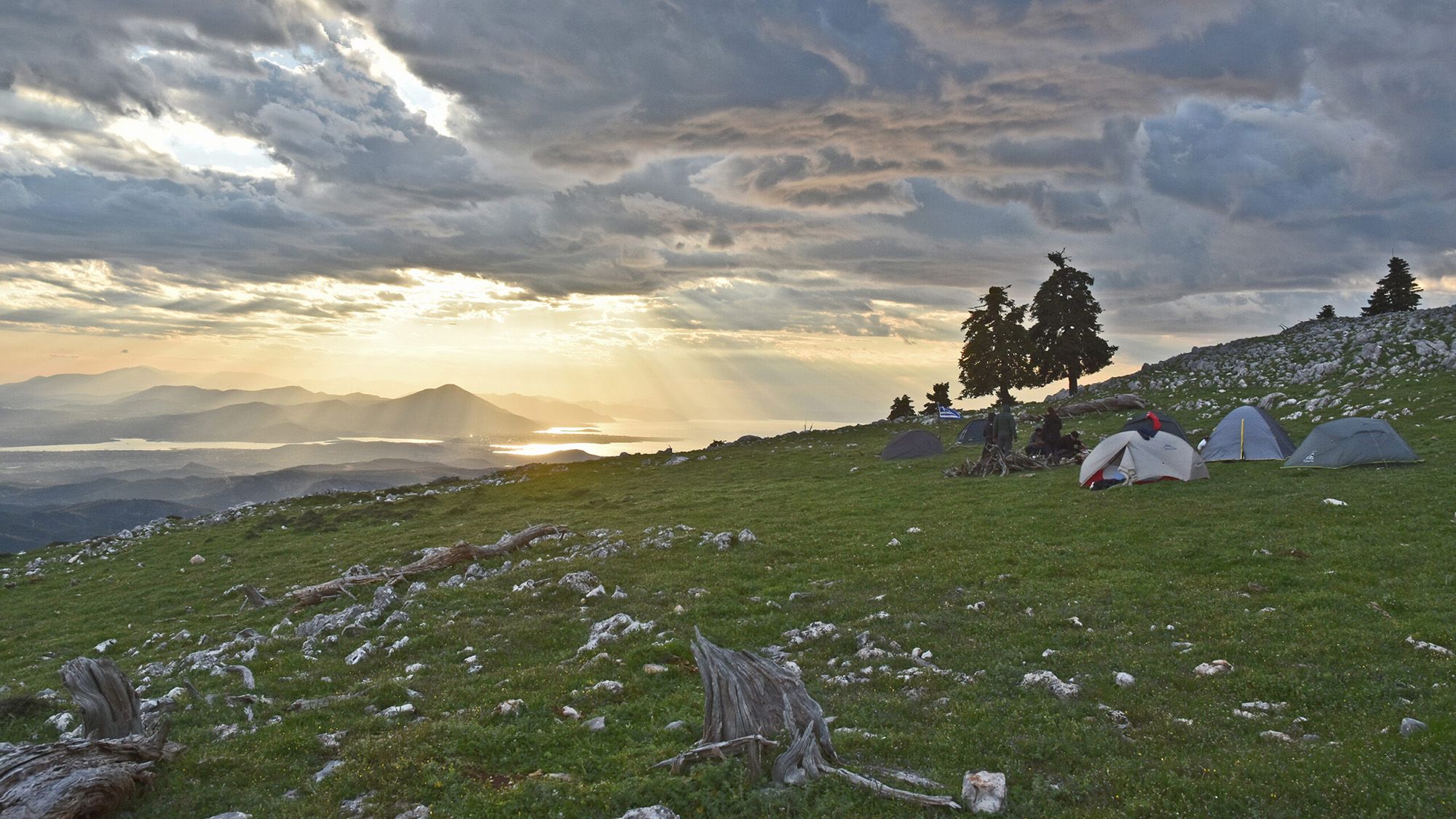
Archaeologists have uncovered a 2,900-year-old open-air sanctuary near the summit of Mount Olympus on the Greek island of Euboea, offering rare physical evidence of sustained high-altitude worship in the ancient Greek world.
The site, excavated by the Swiss School of Archaeology in Greece, yielded an exceptional concentration of pottery spanning from the ninth century B.C. through the Roman imperial period, alongside burned animal bones that point to centuries of sacrificial feasting.
The discovery illuminates how ancient Greeks integrated dramatic landscapes into their religious practice, turning a difficult mountain ascent into a recurring act of devotion.
A Sanctuary Without Walls
The sanctuary sits on Elatias, one of the highest peaks of the Euboean Olympus, roughly 30 miles northeast of Athens. Unlike the monumental temples that dominate popular images of Greek religion, this site featured no buildings at all. Instead, worshippers gathered in the open air, leaving offerings in rock crevices and sharing ritual meals.
In plain terms: this was not a temple with priests and statues, but a natural high place where people came repeatedly over centuries to honor the divine through fire, food, and pottery offerings — a practice rooted in the landscape itself.
"We know that in the ancient Greek world, religious life was not limited to large temples and urban sanctuaries," said Chloé Chezeaux, the excavation leader and an archaeologist at the Swiss School of Archaeology in Greece. "There were also many places of worship in the countryside and in the mountains."
The Climb as Ritual
Reaching the sanctuary demanded serious effort. The final approach from the nearest mountain pass covers about three kilometers with 650 meters of elevation gain — roughly an hour's hike for modern researchers. In antiquity, the journey would have been longer and more arduous, though the exact routes remain unknown.
"People were willing to devote considerable time and energy to reaching these places, and in our case they seem to have done so over many generations," Chezeaux noted. The physical challenge of the ascent likely formed part of the religious experience itself, a bodily enactment of dedication that distinguished mountain worship from city-based rites.
Pottery as a Timeline
The site's most striking feature is the sheer volume of ceramics. The earliest fragments date to the early Greek Geometric period (ninth century B.C.), named for the distinctive linear patterns decorating pottery of that era. Finds continue unbroken through the Archaic, Classical, Hellenistic, and Roman periods, ending around the first or second century A.D.
This continuous sequence suggests the sanctuary remained active for more than a thousand years — an unusually long lifespan for a rural cult site. The pottery styles also link the visitors primarily to Eretria, the nearest major city and the current base of the Swiss School's operations on the island.
Artemis on the Heights
While Zeus is the god most famously associated with mountaintops in Greek tradition, an inscription from Eretria mentions "Artemis Olympia" — an epithet linking the wilderness goddess Artemis to this specific peak. The name Olympus was widely applied to high mountains across the Greek world; the mainland Olympus in Thessaly and Macedonia, traditionally the gods' home, stands at 9,500 feet, while the Euboean summit reaches about 3,800 feet.
No altar has been found, but the animal remains tell their own story. Sheep and goat bones recovered from crevices show clear signs of burning, some at very high temperatures. "These finds naturally suggest practices involving animal sacrifice and ritual meals, which played an important role in ancient Greek religion," Chezeaux said.
The combination of feasting debris and votive pottery fits the pattern of a sanctuary where communities gathered periodically to honor a deity through shared consumption of sacrificial meat.
Landscape and Memory
Mount Olympus dominates the Euboean skyline, visible across much of the island's territory. Its prominence likely made it a natural focal point for religious attention long before the first Geometric pottery was deposited. Eretria itself maintained a rich network of sanctuaries both within its walls and across its countryside; the mountain site extended that network into the vertical dimension.
The discovery adds to a growing body of evidence that Greek religion was deeply topographical. Mountains, caves, springs, and groves were not merely backdrops for worship but active participants in it. The Euboean sanctuary demonstrates how a specific place could retain sacred significance across political and cultural transformations — from the early Iron Age through the Roman occupation.
Questions That Remain
Several mysteries persist. The absence of an altar or built structure makes it difficult to reconstruct the precise choreography of rituals. The identity of the primary deity rests on a single inscription from a different site. And the routes worshippers followed — whether processional paths from Eretria or trails from scattered rural settlements — have left no clear archaeological trace.
What is clear is that generation after generation undertook the steep climb, carrying pottery and animals to a windy summit, and did so consistently for over a millennium. In a religious landscape often defined by its monumental architecture, this humble mountaintop site reminds us that the most enduring sacred spaces were sometimes the simplest: a high place, a fire, and the effort required to reach them.
Was this clear?
library_booksSource
Live Science
24 Nov 2026
- funding model
- commercial media
- owner
- Future plc
Was the source link correct?
topicRelated Articles

Nifty Gateway's Summer 2020 Drops Signal Maturation of Blockchain-Based Art Market

Gemini Engineers Dynamic 3D NFT Badges for Employee Onboarding Using Three.js

Gemini Security Analyst Reveals How AiTM Phishing Bypasses MFA and How Simple Fixes Stop Attackers

Cryptocurrency Wallets Decoded: The Cryptographic Infrastructure Securing Digital Assets

Homo erectus inhabited rainforest environments alongside Denisovans, new research reveals

Congress MP Asserts Opposition Unity Against Delimitation Bill, Citing Constitutional Defense

Love as Resistance: Dalit-Feminist Anthology Reframes Intimacy as Political Defiance Against Caste
