
President Murmu Urges Ayurvedic Colleges to Champion Evidence-Based Practice for a Developed India
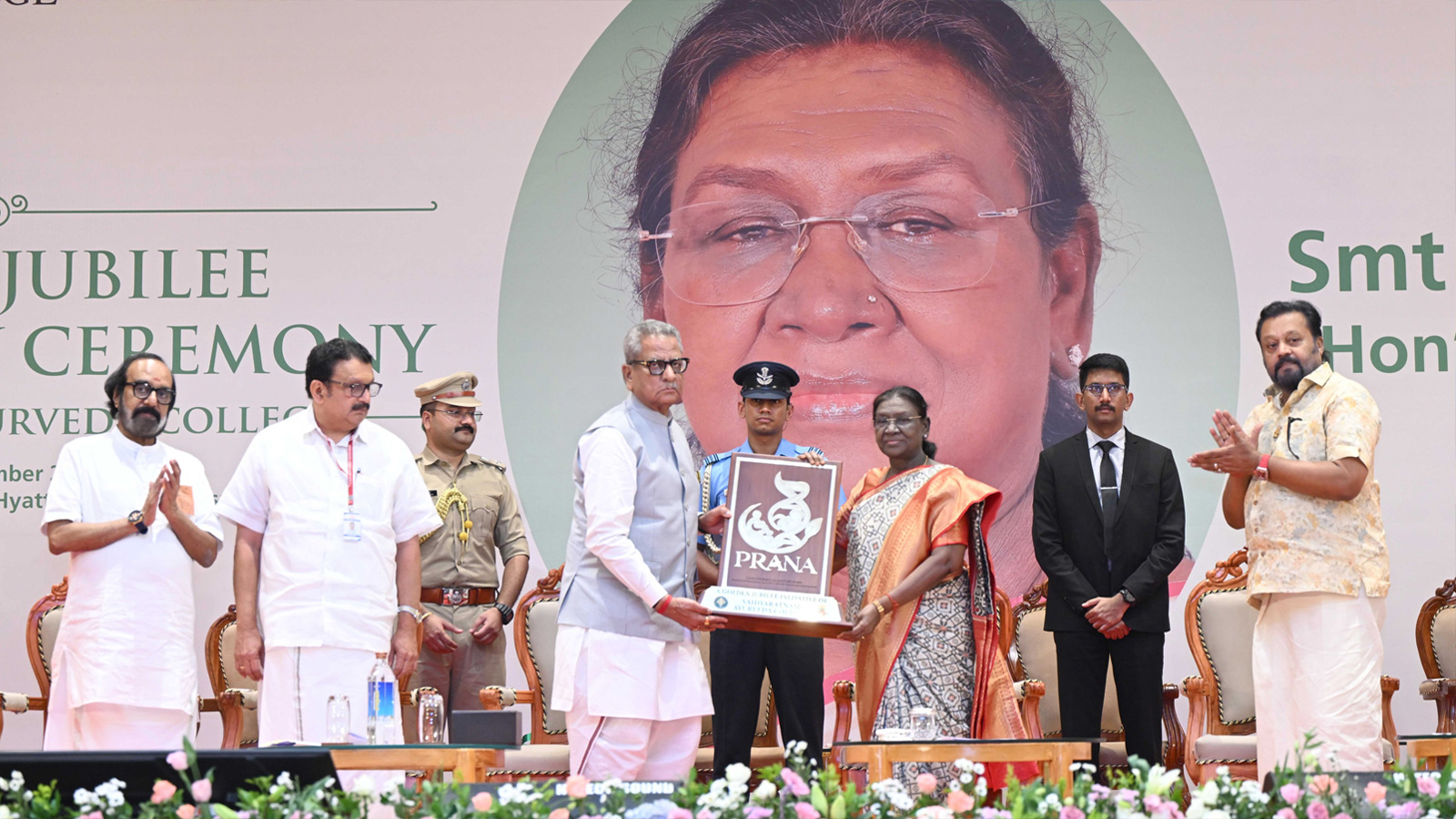
President Droupadi Murmu on Friday called on India's Ayurvedic institutions to anchor their education, research, and clinical practice in rigorous scientific validation, positioning traditional medicine as a strategic pillar of the nation's 2047 development vision.
Addressing the valedictory ceremony of the Golden Jubilee celebrations at Vaidyaratnam Ayurveda College in Thrissur, Kerala, the President framed the pursuit of "authentic, effective, and evidence-based Ayurveda" not merely as an academic exercise but as a national imperative for a "healthy and developed India."
Kerala's Living Tradition as a National Asset
The President singled out Kerala's unique contribution to the field, noting that the state has nurtured a "rich and living tradition" of classical learning that extends well beyond the preservation of Sanskrit texts. Original works and commentaries have been produced for centuries in Malayalam and Manipravalam — a hybrid literary language blending Sanskrit and Malayalam — making the knowledge system accessible and dynamic.
Explain it simply: Manipravalam was a scholarly language used in medieval Kerala that mixed Sanskrit vocabulary with Malayalam grammar, allowing complex medical theories to be taught and debated in the vernacular.
She cited foundational texts such as Chikitsa-Manjari, Aalattur Manipravalam, and Sahasra-Yogam as products of this vernacular scholarship. This tradition, she argued, is not a museum piece but a functional reservoir of clinical wisdom, sustained by generations of Vaidya (physician) families who have continuously prepared authentic medicines and treated patients.
The Ashtavaidya Legacy
Central to this ecosystem are the Ashtavaidya families, traditional scholar-practitioners who have preserved the Ashtanga Hridayam — a core classical text — through a rigorous system of study, interpretation, and practice. The President underscored the "national importance" of systematically documenting the manuscripts, treatment methods, and practical knowledge held by these families.
Their expertise spans specialized domains like Agada-Tantra (toxicology), Kaumara-bhritya (paediatrics), and Marm Chikitsa (therapy targeting vital body points), alongside the community-based use of medicinal plants.
Explain it simply: The Ashtavaidyas are hereditary Brahmin physician families in Kerala who have maintained an unbroken lineage of Ayurvedic practice and education for centuries, specializing in the eight branches of classical medicine.
Constitutional Foresight Meets Modern Policy
She recalled that members like H. V. Kamath, R. V. Dhulekar, Seth Govind Das, and Dr. B. Pattabhi Sitaramayya had explicitly argued for state-backed scientific research into Ayurveda, Unani, and Homoeopathy. That constitutional foresight, she noted, anticipated the very debates — on standardization, efficacy, and integration — that occupy national and international forums today.
From Constituent Assembly Debates to "One Herb, One Standard"
The President highlighted the Ministry of Ayush's "One Herb, One Standard" programme as a modern embodiment of that constitutional mandate. The initiative aims to establish uniform, pharmacopoeial standards for single medicinal herbs, ensuring that a specific plant species meets defined quality benchmarks regardless of where it is sourced or processed.
Explain it simply: "One Herb, One Standard" is a quality-control framework that assigns a single, rigorous chemical and biological fingerprint to each medicinal plant, preventing adulteration and ensuring consistency in herbal medicines.
Complementing this domestic push is the WHO Global Traditional Medicine Centre in Jamnagar, Gujarat. Established with Indian government support, the centre functions as a global knowledge hub, applying modern science, data analytics, and technology to validate traditional medicine practices for worldwide adoption.
Panchakarma
The President identified Panchakarma — Ayurveda's signature detoxification and rejuvenation therapy — as a domain where Kerala could establish global leadership. She referenced an authentic study of the Ayush service sector indicating the state's potential to become an "international reference point for authentic and scientifically evaluated Panchakarma."
Geography, Botany, and the Classical Texts
Achieving this requires collaborative research that bridges classical theory and modern ecology. President Murmu pointed to the Charaka Samhita, Sushruta Samhita, and Ashtanga Hridayam, which explicitly describe how soil composition, water quality, seasonal variations, and geography influence the potency of medicinal plants.
Systematic, multi-institutional studies of these variables could build a comprehensive knowledge database, strengthening the scientific foundation of Ayurvedic pharmacology.
Explain it simply: Classical Ayurvedic texts recognized that the same herb grown in different soils or harvested in different seasons can have different medicinal strengths; modern science can now measure and standardize these variations.
She urged government bodies, private institutions, and Ayurvedic colleges across Kerala to launch joint research projects with the Jamnagar centre and other reputed organizations to realize this vision.
Service, Philanthropy, and the Social Contract
Beyond research and education, the President emphasized the social contract inherent in Kerala's Ayurvedic tradition: the integration of professional practice with philanthropy. She urged students to carry forward this ethos, demonstrating that "traditional knowledge-based enterprises and service to underprivileged communities can progress together."
Training Vaidyas for Emerging Health Challenges
The President expressed satisfaction that Vaidyaratnam Ayurveda College's work ethos aligns with this dual mandate. She stressed that institutions combining authentic healthcare delivery with relevant education produce practitioners capable of responding to emerging health challenges — from lifestyle diseases to antimicrobial resistance — where conventional systems face limitations.
Concluding her address, President Murmu conveyed her best wishes to the college fraternity, expressing hope that Ayurveda would continue to enhance its capabilities in serving humanity, "particularly the underprivileged sections of society." The message was clear: the path to a Viksit Bharat (Developed India) runs through laboratories and clinics where tradition meets evidence, and where the healer's duty extends to the last person in the queue.
Was this clear?
library_booksSource
DD News
27 Nov 2026
- funding model
- government funded (public service broadcaster)
- jurisdiction
- India
- jurisdiction
- India
- owner
- Doordarshan (Prasar Bharati), the public service broadcaster of the Government of India, Ministry of Information & Broadcasting
Was the source link correct?
topicRelated Articles

FSSAI Authorizes Second Prosecution Against Bisleri in a Week Over Bacterial Contamination

Gemini Rolls Out Enhanced Investor Protections for UK Users Under New FCA Financial Promotions Rules

Crypto Emerges as Decisive Voting Issue in 2024 US Presidential Election, Survey Finds

Gemini Warns of Web3 Talent Exodus as U.S. Regulatory Uncertainty Deepens at Consensus 2024

Gemini's Legal Chief Calls for Clean-Slate Crypto Regulation, Rejects Howey Test and Dual SEC-CFTC Oversight

Trump's Crypto Reserve Plan, SEC Task Force, and Senate Vote Signal Major Shift in US Digital Asset Policy

Haryana Panchayat Cyber Fraud Exposes Systemic Vulnerabilities in Government Digital Payment Infrastructure
