
Two Decades of Simulated Justice: How China's IHL Moot Court Shaped a Generation of Humanitarian Lawyers
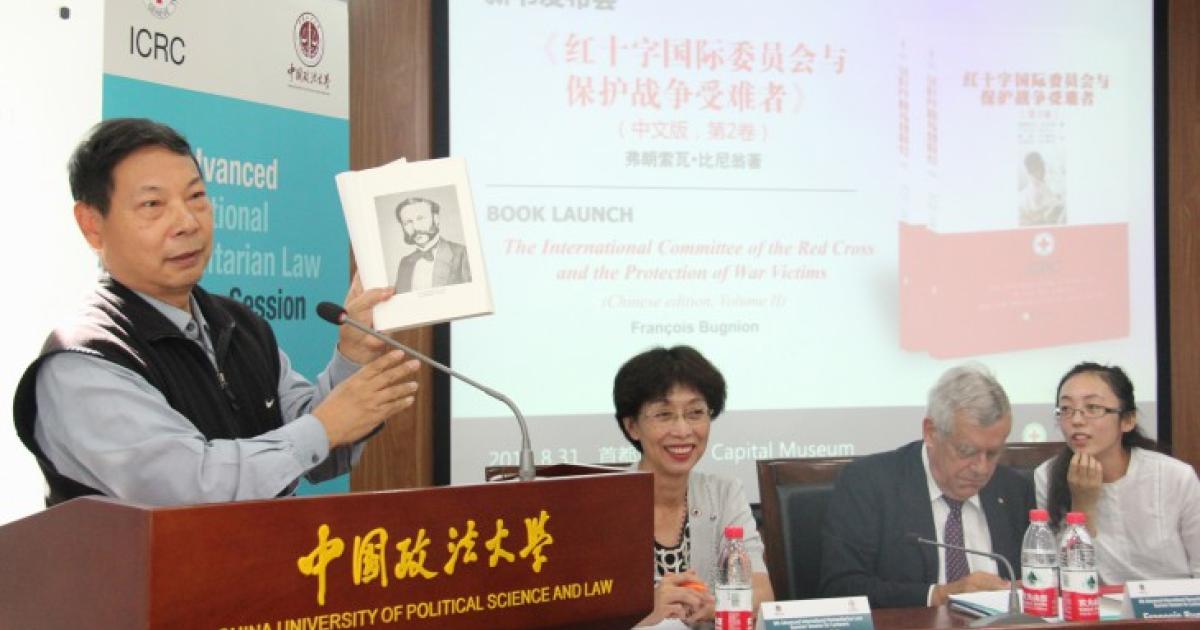
The 20th anniversary of the International Humanitarian Law (IHL) Moot Court Competition in China marks a milestone in legal education, transforming passive learning into active advocacy through simulated war crimes trials.
The Genesis
Its core purpose is to limit the effects of warfare by protecting those who are not participating in hostilities, such as civilians, wounded soldiers, and prisoners of war, and by restricting the means and methods of warfare.
Put simply: Even in war, there are rules. IHL is the legal framework that says you cannot target civilians, you must treat prisoners humanely, and you cannot use weapons that cause unnecessary suffering. It is the legal expression of the idea that war, while sometimes inevitable, must not descend into barbarism.
As Professor Zhu Wenqi, a founding figure of the competition and one of China's most senior IHL experts, notes, the persistence of conflicts like those in Ukraine and the Middle East makes these rules tragically relevant. Despite humanity's desire for peace, armed conflict remains a reality; IHL provides the legal guardrails that prevent total lawlessness.
China, as a permanent UN Security Council member and party to the 1949 Geneva Conventions and their 1977 Additional Protocols, has a distinct obligation to study and disseminate these rules.
The ICRC's Unique Role as Guardian and Educator
The competition exists because of the International Committee of the Red Cross (ICRC), an organization with a mandate unlike any other. Founded in 1863, the ICRC is the guardian of the Geneva Conventions. It operates as a neutral, independent humanitarian body with a permanent mandate under international law to protect victims of armed conflict.
In practical terms: The ICRC visits prisoners of war and civilian internees to monitor their treatment, runs tracing services to reunite families separated by conflict, and coordinates humanitarian relief in war zones. Crucially, it is also tasked with "dissemination" — spreading knowledge of IHL to armed forces, authorities, and civil society.
The moot court program in China is a direct extension of this educational mandate, funded and guided by the ICRC's East Asia Regional Delegation in Beijing under a headquarters agreement with the Chinese government.
From Classroom to Courtroom
The competition's format is deceptively simple: teams argue a hypothetical case based on a complex armed conflict scenario before panels of experts acting as judges. But its educational impact is profound. Traditional legal education often relies on lectures and rote memorization of statutes. The moot court flips this model.
Here is why it works: Students must master the treaties, but then apply them to messy, ambiguous facts — distinguishing combatants from civilians, assessing proportionality in attacks, determining command responsibility. They learn to think like lawyers, not just students.
As Professor Zhu emphasizes, the exercise fuses knowledge, skills, and professional values: critical thinking, oral advocacy, and ethical reasoning are developed simultaneously. Participants move from passive recipients of information to active investigators of legal problems.
Two Decades of Growth
The trajectory mirrors China's broader engagement with international law. By 2007, the fifth Asia-Pacific regional round was hosted in Beijing. The 20th edition, concluded in November 2026, saw China Ocean University emerge as champions after a field that drew from over 70 law schools nationwide.
This expansion reflects a deliberate strategy. Many alumni, such as those featured in the anniversary series — Dr. Song Tianying, Chen Xinyue, Yu Runian, and others — have gone on to careers in international organizations, diplomacy, and academia, carrying the IHL framework into professional practice.
Legacy and Future
The ultimate measure of the competition's success is not the number of trophies awarded, but the normalization of humanitarian legal reasoning within China's legal ecosystem. In a world where compliance with IHL is frequently challenged, building a domestic constituency of lawyers, judges, and officials who understand the Geneva Conventions as living law — not abstract text — is a strategic investment.
As the competition enters its third decade, its organizers face the challenge of keeping scenarios current with evolving warfare — cyber operations, autonomous weapons, urban siege tactics — while maintaining the rigorous academic standards that have defined its first 20 years. The goal remains unchanged: to ensure that when the next generation of Chinese legal professionals encounters the fog of war, they reach for the rulebook.
Was this clear?
library_booksSource
International Committee of the Red Cross
17 Nov 2026
- funding model
- non-profit (grants, donations)
- jurisdiction
- International
- owner
- Non-governmental organization (International Committee of the Red Cross)
Was the source link correct?
topicRelated Articles

Congress MP Asserts Opposition Unity Against Delimitation Bill, Citing Constitutional Defense

Love as Resistance: Dalit-Feminist Anthology Reframes Intimacy as Political Defiance Against Caste

Rajasthan SOG Busts Interstate Racket Selling Forged Medical Degrees; Class 11 Dropout Posed as Doctor at Safdarjung

Four Killed in Rohtak Hotel Shooting; Police Investigate Alleged Honey-Trap Ambush

Delimitation Bill Framed as Trojan Horse to Reshape India's Electoral Map

Vijay's TVK Labels Stalin 'Savarkar 2.0' in Sharp Delimitation Offensive

Rohit Sharma Reveals Reluctance Behind Mumbai Indians Captaincy Return
