
Vidhi Fellow Ananya Upadhya Examines Printer's Legal Right to Refuse in Deccan Herald Opinion
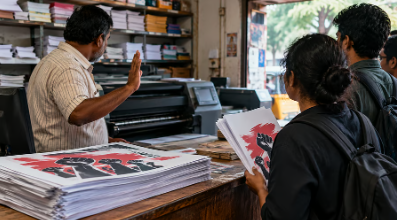
On October 30, 2026, the Deccan Herald published an opinion piece by Ananya Upadhya, a Research Fellow at the Vidhi Centre for Legal Policy, titled "Stop the press(ure): What the law says about printer's right to refuse?" The article interrogates the legal boundaries surrounding a printer's discretion to decline specific printing jobs, a question that sits at the intersection of constitutional law, anti-discrimination statutes, and the evolving definition of press freedom in India.
Author's Legal Pedigree Informs Analysis
Upadhya brings a distinctive blend of academic rigour and practical regulatory experience to the subject. A gold medallist from the B.A. LL.B. (Hons.) programme at National Law University Delhi, she has previously worked extensively on the "Pressing Charges" report, a collaborative project with Columbia Law School examining journalistic freedoms.
That background provides her with a grounded perspective on the operational pressures faced by news organisations and the legal frameworks that govern them.
Before joining Vidhi, Upadhya practiced at Khaitan & Co, one of India's premier law firms, where she operated in the fintech and financial regulatory space. Her work there involved due diligence, legal advisory, and contractual negotiations for banks, non-banking financial companies, payment aggregators, and cryptocurrency entities.
This exposure to technology law and platform governance — areas she identifies as keen interests — equips her to analyse how traditional legal principles apply to modern commercial relationships.
The Central Question
The title of the piece, "Stop the press(ure)," signals a focus on the tension between a printer's commercial obligations and their potential right to refuse service based on the content requested.
In plain terms, the issue is whether a printing business can legally say "no" to a customer who wants to print material the printer finds objectionable, or whether anti-discrimination laws compel them to serve all comers regardless of content.
This is not merely a theoretical debate; it has direct implications for newspaper publishers, commercial print shops, and potentially digital platforms that function as modern-day printers.
Intersection of Technology Law and Constitutional Rights
Upadhya's stated research interests — technology law (especially platform governance), constitutional law, and international trade law — converge in this analysis. The question of a printer's right to refuse echoes broader debates about intermediary liability and content moderation.
Just as social media platforms grapple with the right to remove or refuse content, traditional printers face analogous legal uncertainties.
The piece likely explores whether constitutional protections for freedom of speech and expression extend to the right not to speak — or not to print — and how statutes like the Indian Penal Code or the Information Technology Act might intersect with that right.
Previous Work on Journalistic Freedoms
The "Pressing Charges" report, on which Upadhya worked during her time at NLU Delhi, investigated the legal and extralegal pressures on journalists in India. That project involved documenting cases of censorship, legal harassment, and violence against the press.
Her transition from documenting threats to journalistic freedom to analysing the legal rights of the printing infrastructure itself represents a logical deepening of her focus. The printer, after all, is the physical enabler of the press; legal vulnerabilities at that layer can effectively silence publication before it reaches the public.
Fintech and Regulatory Experience Adds Dimension
Her stint at Khaitan & Co advising cryptocurrency entities and payment aggregators adds another layer of relevance. In the fintech sector, the refusal of service — whether by a bank, a payment gateway, or a platform — is a live regulatory issue. The principles governing when a regulated entity may decline a customer are contested globally.
Upadhya's familiarity with those contests likely informs her approach to the printer's dilemma, allowing her to draw parallels between a payment processor cutting off a merchant and a print shop declining a pamphlet.
A Voice in the Public Discourse
Beyond her fellowship at Vidhi, Upadhya has contributed over 50 articles to JURIST News, where she served as South Asia Chief of Staff, and has written for the Financial Express and Constitutional Law and Philosophy. This track record of public legal commentary suggests the Deccan Herald piece is part of a sustained effort to translate complex legal questions into accessible public discourse.
The publication in a major national daily ensures the analysis reaches policymakers, legal practitioners, and the general public simultaneously.
The opinion piece arrives at a moment when the relationship between commercial service providers and expressive content is under intense scrutiny globally. From wedding cake bakers in the United States to social media platforms in India, the line between discrimination and editorial discretion is being litigated and legislated.
Upadhya's contribution applies her specific expertise — spanning constitutional theory, press freedom advocacy, and technology regulation — to the Indian iteration of this global debate.
Was this clear?
library_booksSource
Vidhi Centre for Legal Policy
2 Nov 2026
- jurisdiction
- India
- jurisdiction
- India
- jurisdiction
- India
- jurisdiction
- India
- jurisdiction
- India
- jurisdiction
- India
- jurisdiction
- India
- jurisdiction
- India
- jurisdiction
- India
- jurisdiction
- India
- jurisdiction
- India
- jurisdiction
- India
- jurisdiction
- India
- jurisdiction
- India
- jurisdiction
- India
- jurisdiction
- India
- jurisdiction
- India
- jurisdiction
- India
- jurisdiction
- India
- jurisdiction
- India
- jurisdiction
- India
- jurisdiction
- India
- jurisdiction
- India
- jurisdiction
- India
- jurisdiction
- India
- jurisdiction
- India
Was the source link correct?
topicRelated Articles

Congress MP Asserts Opposition Unity Against Delimitation Bill, Citing Constitutional Defense

Love as Resistance: Dalit-Feminist Anthology Reframes Intimacy as Political Defiance Against Caste

Rajasthan SOG Busts Interstate Racket Selling Forged Medical Degrees; Class 11 Dropout Posed as Doctor at Safdarjung

Four Killed in Rohtak Hotel Shooting; Police Investigate Alleged Honey-Trap Ambush

Delimitation Bill Framed as Trojan Horse to Reshape India's Electoral Map

Vijay's TVK Labels Stalin 'Savarkar 2.0' in Sharp Delimitation Offensive

Rohit Sharma Reveals Reluctance Behind Mumbai Indians Captaincy Return
