
AI Poised to Rewrite Pharma Economics, Elevating Drug Makers to Tech-Giant Valuations
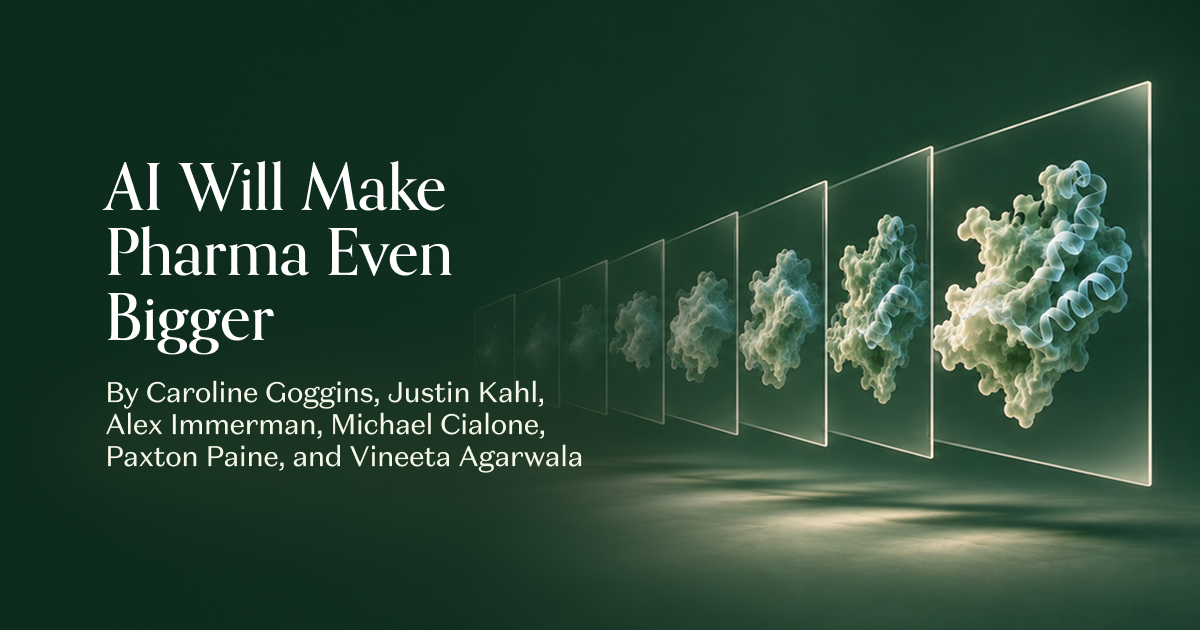
Venture capital firm Andreessen Horowitz argues that artificial intelligence is on the verge of fundamentally altering the economics of drug development, potentially allowing pharmaceutical companies to achieve the scalable, platform-driven valuations historically reserved for software giants.
In a detailed market analysis, the firm highlights how AI-driven improvements in success rates and development timelines could break the decades-long trend of declining R&D productivity known as Eroom's Law, turning drug discovery from a low-probability lottery into a repeatable engineering discipline.
The Trillion-Dollar Pharma Landscape
The financial scale of the modern pharmaceutical industry already rivals that of Big Tech. Eli Lilly’s market capitalization has surpassed $1 trillion, placing it in an elite club historically dominated by technology and infrastructure giants.
The top 30 pharmaceutical companies collectively represent roughly $5 trillion in market value, with nine publicly traded firms valued above $200 billion—a count comparable to the 16 software companies in the same bracket.
In the third quarter of 2026 alone, Lilly’s GLP-1 portfolio generated nearly $17 billion in revenue, a figure approaching the quarterly revenue of leading AI labs like Anthropic. Analysts project this single franchise could exceed $100 billion in annual sales by 2030.
Explain it simply: The drug industry is already as big and valuable as the software industry. A single successful drug franchise can now generate revenue on par with the largest technology companies.
The Dual Economics of Drug Development
A Hits Business
Pharmaceutical economics operate on a power law: the top 25% of drugs generate approximately 85% of revenues. For the ten largest pharma companies, roughly half of all revenue comes from just three assets. In 2025, 63% of Lilly’s revenue came from its GLP portfolio, while 54% of Merck’s revenue depended on a single drug, Keytruda.
This extreme concentration makes the industry a "hits business" akin to venture capital or blockbuster entertainment, where a few outliers drive the majority of returns.
Explain it simply: Like a movie studio that relies on a few blockbusters to pay for all the flops, drug companies depend on a tiny number of mega-hits to fund their entire operations.
Valuable Annuities
Once a drug succeeds, it transforms into a durable annuity. Patent protection typically provides 10 to 14 years of market exclusivity after commercial launch. The most successful drugs—dubbed "modelbusters"—can generate $30 billion or more in annual peak sales for a decade or longer.
Lilly’s injectable GLP-1 drugs Mounjaro and Zepbound recorded nearly $40 billion in sales in 2025, roughly matching the annual revenue of Salesforce. Even standard "blockbuster" drugs crossing the $1 billion annual sales threshold number around 300 globally, a count similar to the number of public software companies in that revenue tier.
Explain it simply: A hit drug becomes a money-printing machine for over a decade, protected from competition by patents, creating a reliable, massive cash flow stream.
How AI Could Rewrite the Economics
From Scarcity to Abundance
Despite soaring R&D spending, the FDA approves only 40 to 50 novel drugs annually. The present-value cost of developing a single approved drug approaches $2 billion over an average of 13 years, with less than 5% of candidates surviving from discovery to approval. AI promises to invert this calculus by simultaneously increasing the probability of success and decreasing the time to approval.
Formation Bio, an a16z portfolio company, predicts an coming era of drug candidate "abundance," where AI accelerates target identification, molecular design, clinical trial protocol generation, patient recruitment, and regulatory document drafting.
This shift threatens to explode demand for wet-lab validation. The global contract research organization (CRO) market already stands at $90 billion annually. As AI generates candidates faster, the bottleneck will shift to physical experimentation, creating opportunities for robotic lab automation and high-throughput data providers.
Valuing the Discovery Engine
Currently, pharma valuations rely on discounted cash flows from approved or late-stage drugs, applying price-to-earnings multiples of 8x to 20x. Investors give little "credit" to early-stage discovery engines because their output is too uncertain and distant. Software companies, by contrast, are valued on their platforms' ability to generate recurring revenue and expand into new products.
If AI makes drug discovery repeatable and predictable, investors may begin assigning platform value to pharma R&D engines—similar to how they value cloud infrastructure or AI models. This would lower the cost of capital for biotech startups, which have historically been forced to deprioritize platform investment in favor of advancing single assets. a16z has already launched The Biotech Ecosystem Fund, a joint venture with Eli Lilly, to accelerate this transition.
Explain it simply: If investors trust a company's AI "engine" to reliably churn out new drugs, they'll value the company like a tech platform, not just a portfolio of expiring patents.
Why the AI Inflection Is Happening Now
Two Vectors of Progress
For decades, drug discovery has obeyed Eroom's Law—getting slower and more expensive despite computing advances. The analysis identifies two converging AI capabilities finally reversing this trend.
First, large language and reasoning models are automating knowledge work across the R&D lifecycle: literature synthesis, experimental design, data analysis, and regulatory filing. Second, diffusion-based structure prediction models have become indispensable for de novo molecular generation and optimization, applicable to both biologics and small molecules.
Explain it simply: One type of AI reads and thinks like a scientist; the other imagines and designs molecules like an architect. Together, they cover the whole discovery process.
The firm compares the current moment to the "GPT-3 level" of maturity for biology-AI—an inflection where single models demonstrate broad, generalizable capability across many tasks with minimal task-specific training. Over the next five years, this foundation is expected to enable a wave of AI-native therapeutic companies that develop their own drugs rather than merely selling software to incumbents.
The Human Stakes
Beyond market mechanics, the analysis emphasizes the human imperative. Thousands of diseases lack any treatment, let alone cures. The convergence of biological data, computational scale, and model sophistication offers the first credible path to systematically addressing this unmet need. If the economics shift as predicted, the industry could take more "shots on goal," pursuing targets previously deemed uneconomical and ultimately delivering novel therapies to patients faster and at lower cost.
Was this clear?
library_booksSource
Andreessen Horowitz
13 Nov 2026
- funding model
- venture capital (LP/GP fund structure)
- jurisdiction
- USA
- owner
- Andreessen Horowitz (a16z, founded by Marc Andreessen and Ben Horowitz)
Was the source link correct?
topicRelated Articles

Gemini Launches BitcoinBuzz: A Composite Sentiment Indicator for Bitcoin Markets

Prediction Markets Emerge as Real-Time Forecasting Engines for Finance, Policy, and Sports

Cryptocurrency Mining in 2026: Emerging Strategies for Zero-Cost Operations
Square Expands Subscription Management Tools for Merchants with New Dashboard Controls

Canadian Robotic Exoskeleton Enables First Steps for British Boy with Rare Epilepsy

Congress MP Asserts Opposition Unity Against Delimitation Bill, Citing Constitutional Defense

Love as Resistance: Dalit-Feminist Anthology Reframes Intimacy as Political Defiance Against Caste
