
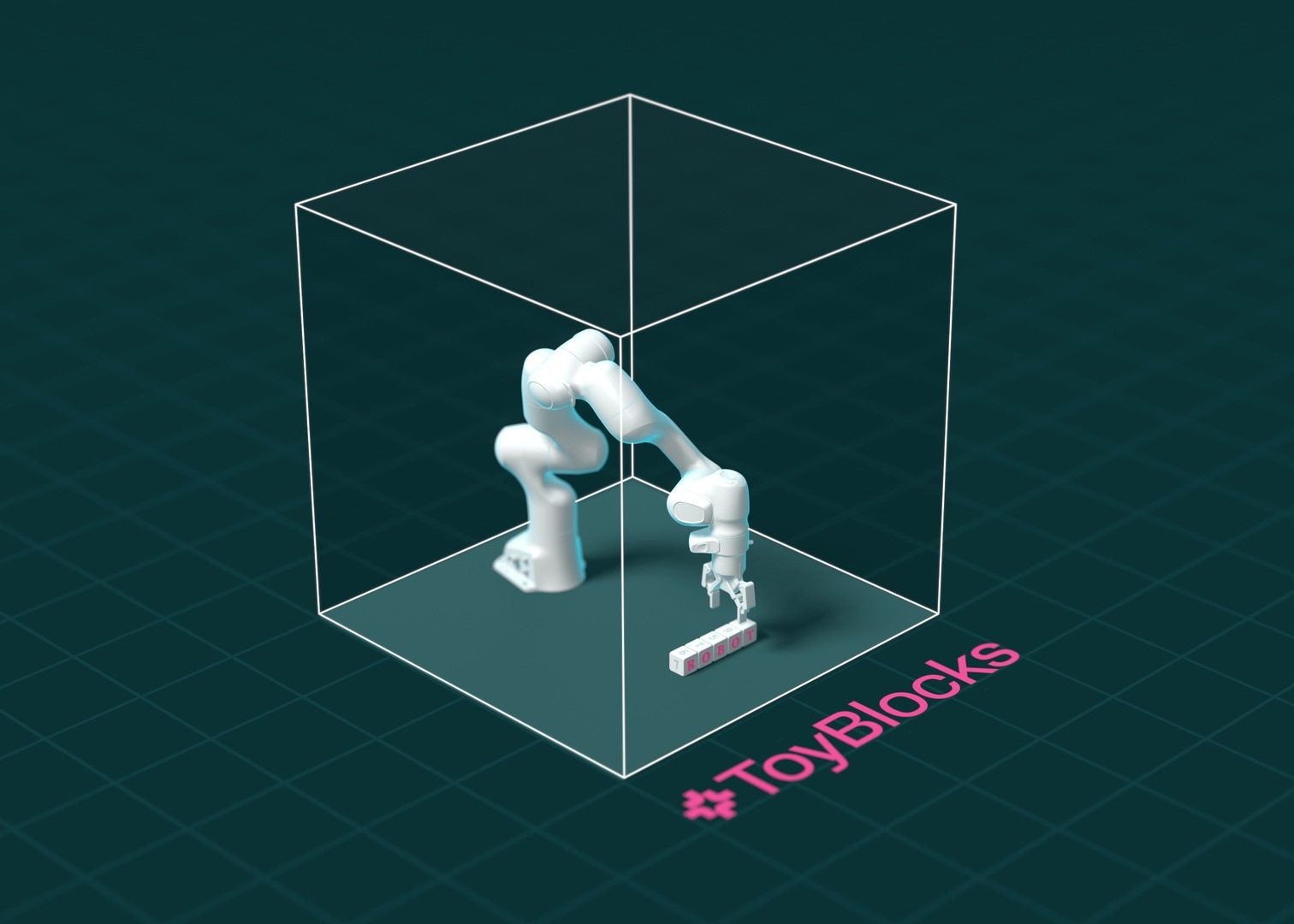
The Allen Institute for AI (Ai2) has released ToyBlocks, an open simulation framework designed to serve as a "FoundationWorld" — a controlled, reproducible environment where researchers can systematically vary training data, model architectures, and task conditions to understand how robots learn and why they fail.
Built around a simulated robot arm manipulating blocks on a tabletop, ToyBlocks automates the generation of tasks and demonstrations at scale, enables precise measurement of generalization, and provides a testbed for studying the interplay between high-level reasoning and low-level dexterity.
The framework addresses a persistent gap in robotics: demonstrations of folding laundry or sorting parts often lack the controlled conditions needed to isolate cause and effect in learning.
The FoundationWorld Concept
ToyBlocks is the first instance of what Ai2 calls a FoundationWorld: a paired simulation environment and toolset targeted at a specific robotics domain.
Each FoundationWorld must satisfy four requirements: realistic physics and appearance, automatic generation of tasks and demonstrations at scale, challenges that combine reasoning with dexterity, and broad coverage of tasks possible within the domain.
By deliberately narrowing scope to a tabletop block-manipulation setting, ToyBlocks achieves all four — something infeasible in open-ended domains with vast object and interaction variety.
In simpler terms, think of ToyBlocks as a petri dish for robotics. Just as biologists use controlled cultures to test hypotheses about cellular behavior, roboticists can now use ToyBlocks to test hypotheses about how training data composition, model design, or environmental variation affect a robot's ability to generalize.
The blocks carry pictures and letters on their faces, enabling tasks that require search, sorting, and spatial reasoning — such as rotating a block to reveal a hidden letter before deciding where to place it.
Automated Skill and Demonstration Generation
A core innovation is ToyBlocks' ability to generate training data without human teleoperation. Low-level skills — short-horizon behaviors like pushing, flipping, or rotating a block — are learned through reinforcement learning in Nvidia's Isaac Lab. These policies can access privileged simulator information (exact block pose) during training, enabling automatic acquisition of non-prehensile skills that would otherwise require painstaking human demonstration.
To stitch skills into full task demonstrations, a task-and-motion planner (TAMP) automatically selects and sequences skills, plans robot motions between them, and executes hundreds of plans in parallel on a single GPU. The system achieves up to 24 times real-time performance, producing labeled datasets of demonstrations alongside metrics such as execution speed, forces exerted, and task progress.
Researchers can then create controlled training mixtures — emphasizing certain skills, varying workspace coverage, or withholding specific task configurations — and evaluate on held-out tasks.
Probing Vision-Language-Action Model Generalization
ToyBlocks' first major study targets a contentious question: how well do vision-language-action models (VLAs) generalize spatially? Despite large-scale pretraining, popular VLAs including ManiFlow and MolmoAct 2 showed poor generalization in initial ToyBlocks tests.
The framework enabled systematic interpolation and extrapolation studies: training on left-region object spawns and testing on right-region spawns; training on stack heights of 2 and 5 blocks and testing on heights 3 and 4; varying letters, colors, and block counts.
The results challenge assumptions that pretraining alone confers robust spatial generalization. ToyBlocks further allowed the team to analyze improvement techniques — including low-rank adaptation (LoRA) fine-tuning — and quantify each method's contribution. The conclusion: action model generalization remains far from solved, and ToyBlocks provides a reproducible testbed for exploring solutions.
Hierarchical Reasoning
Long-horizon tasks — such as spelling "Ai2" with lettered blocks when letters may be hidden — require a robot to plan information-gathering actions (rotate to reveal a face) and then execute a multi-step manipulation sequence. ToyBlocks supports hierarchical evaluation with explicit high-level planners and low-level policies.
Using Molmo 2 (a vision-language model) as the planner and ManiFlow as the low-level policy, the framework isolates whether failures stem from planning errors or execution errors.
Evaluation across three difficulty settings — upright visible characters, non-upright characters, and initially hidden characters — and two generalization conditions yields granular success rates. The framework also provides oracles (reference components giving correct plans or actions) at both levels, enabling clean attribution of failure modes.
Agentic Systems
ToyBlocks integrates with the Model Context Protocol (MCP), exposing skills as tools that frontier language models can call. In a "search-and-spell" setting, Claude Opus 5.5 receives camera images, points at pixels to invoke skills (pick, flip, rotate), and must find letters among up to eight blocks — with 50% of scenes missing a required letter, requiring the agent to declare infeasibility.
The agent solved or correctly declared infeasible 63% of tasks. Errors were primarily letter confusion (13%) and orientation mistakes (15%).
Strikingly, when blocks carried semantic patterns (e.g., an 'A' block showing apple, ant, airplane), agents declared infeasibility significantly faster by reasoning about occluded faces — demonstrating that structured object representations aid search efficiency.
In a third setting, an agent acted as a scientist: when a skill behaved unexpectedly, it formed hypotheses, designed tests, and revised its understanding. Learned skill descriptions raised success rates from 24% (default descriptions) to 63%, outperforming human-expert-written descriptions (36%).
A Platform for Hypothesis-Driven Robotics
ToyBlocks is open-source, with a web interface allowing non-experts to connect frontier models and issue natural-language commands. By providing a controlled world where every variable — from training data composition to physical parameters — can be manipulated and measured, Ai2 aims to shift robotics from narrow demonstrations toward systematic science.
Was this clear?
library_booksSource
Allen Institute for AI
6 Nov 2026
- funding model
- philanthropic (non-profit, endowed by Paul Allen estate)
- owner
- Allen Institute for AI (founded by Paul Allen) (Founded by Paul Allen 2014)
Was the source link correct?
topicRelated Articles

Gemini Launches BitcoinBuzz: A Composite Sentiment Indicator for Bitcoin Markets

Prediction Markets Emerge as Real-Time Forecasting Engines for Finance, Policy, and Sports

Cryptocurrency Mining in 2026: Emerging Strategies for Zero-Cost Operations
Square Expands Subscription Management Tools for Merchants with New Dashboard Controls

Canadian Robotic Exoskeleton Enables First Steps for British Boy with Rare Epilepsy

Congress MP Asserts Opposition Unity Against Delimitation Bill, Citing Constitutional Defense

Love as Resistance: Dalit-Feminist Anthology Reframes Intimacy as Political Defiance Against Caste
