Bruges Colloquium Urges Action to Protect Wounded, Sick, and Dead in Conflict
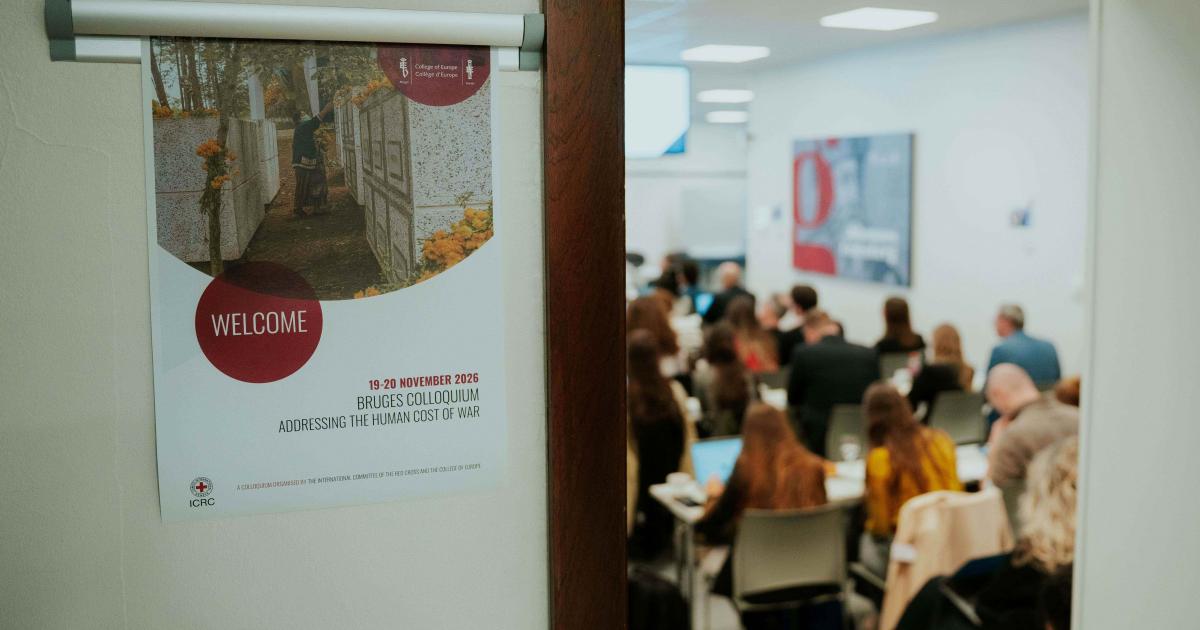
Legal experts, military practitioners, and humanitarian professionals convened in Belgium last month for the 26th Bruges Colloquium on international humanitarian law (IHL), issuing a stark reminder that the rules of war require more than ratification — they demand rigorous implementation.
The two-day gathering, co-organized by the International Committee of the Red Cross (ICRC) delegation in Brussels and the College of Europe, centered on a persistent crisis: the gap between legal obligations to protect the wounded, sick, and dead and the reality on modern battlefields.
The Bruges Colloquium: A Forum for Implementation
Since its inception in 1999, the Bruges Colloquium has served as Belgium’s annual meeting point for IHL specialists to dissect the challenges of faithful implementation. This year’s theme, "Addressing the Human Cost of War: Upholding IHL to Protect the Wounded, Sick and Dead," structured discussions across five panels that traced a chronological arc — from the immediate chaos of the battlefield to the long, agonizing wait of families seeking news of missing loved ones.
International humanitarian law, often called the law of armed conflict, is a set of rules that seeks to limit the effects of war for humanitarian reasons. It protects people who are not or are no longer participating in hostilities and restricts the means and methods of warfare. In simpler terms, it is the rulebook that says even in war, there are lines that cannot be crossed: civilians must be spared, prisoners treated humanely, and the wounded cared for regardless of whose uniform they wear.
From Solferino to Geneva: The Historical Imperative
The colloquium’s discussions were grounded in history. In 1859, Henry Dunant witnessed the aftermath of the Battle of Solferino, where tens of thousands of soldiers lay dead or wounded without care. Moved by the suffering, he mobilized local villagers to tend to the injured irrespective of their allegiance.
His advocacy birthed the first Geneva Convention in 1864 and the founding of the Red Cross movement. Today, the four Geneva Conventions of 1949 stand as the only treaties ratified by every single state on Earth — a universal legal consensus that the wounded, sick, and dead must be respected and protected.
Translating Law into Battlefield Practice
The core of the Bruges debates focused on operationalizing these universal norms. Under IHL, parties to a conflict are obligated to search for and collect the wounded and sick without delay, provide medical care based solely on need — without distinction between friend or foe, military or civilian — and protect them from pillage and ill-treatment.
The dead must be handled with dignity: searched for, collected, evacuated, and identified. These measures are not merely ceremonial; they are the primary mechanism to prevent people from going missing and to spare families the torment of uncertainty.
In practice, this means that a military commander must have clear protocols to evacuate enemy wounded from the battlefield just as they would their own soldiers. It means that after hostilities cease, the obligation to recover and identify remains does not expire.
It means that medical facilities, ambulances, and personnel bearing the protective emblems — the red cross, red crescent, or red crystal — must never be attacked or obstructed. When health care is disrupted, the ripple effects devastate entire communities far beyond the front lines.
The Persistent Gap Between Rules and Reality
Despite 160 years of legal evolution since Dunant’s call, the colloquium highlighted a troubling disconnect. In contemporary conflicts, hospitals are bombed, ambulances are blocked, and the dead are left unrecovered for years. The wounded and sick often languish without care because parties to conflict either ignore their obligations or lack the operational capacity to fulfill them.
Families remain trapped in "waiting rooms," unable to mourn or move forward because the fate of their relatives remains unknown. The experts in Bruges emphasized that the law itself is not the problem; the deficit lies in political will, military training, and accountability mechanisms.
Protecting Healthcare: A Non-Negotiable Obligation
A recurring refrain across the panels was the protection of health-care infrastructure. IHL explicitly shields hospitals, ambulances, and medical staff from attack. The protective emblems are not decorative; they signal a legal guarantee that those caring for the wounded and sick — and the facilities they operate in — are off-limits. Yet violations persist.
The ICRC used the platform to remind all parties to conflict that medical care is not a bargaining chip. Even in the most brutal wars, the space for humanity must be preserved, because once the medical system collapses, the distinction between combatant and civilian survival erodes entirely.
The Bruges Colloquium did not produce a treaty or a binding resolution. Its value lies in its role as a pressure valve for accountability — a space where practitioners confront the hard cases, share operational lessons, and recommit to the unglamorous work of turning legal text into lived reality.
As the discussions made clear, the rules of war are only as strong as the willingness to enforce them. The wounded, the sick, the dead, and the families waiting for them cannot afford the luxury of patience.
Was this clear?
library_booksSource
International Committee of the Red Cross
25 Nov 2026
- funding model
- non-profit (grants, donations)
- jurisdiction
- International
- owner
- Non-governmental organization (International Committee of the Red Cross)
Was the source link correct?
topicRelated Articles

Gemini Rolls Out Enhanced Investor Protections for UK Users Under New FCA Financial Promotions Rules

Crypto Emerges as Decisive Voting Issue in 2024 US Presidential Election, Survey Finds

Gemini Warns of Web3 Talent Exodus as U.S. Regulatory Uncertainty Deepens at Consensus 2024

Trump's Crypto Reserve Plan, SEC Task Force, and Senate Vote Signal Major Shift in US Digital Asset Policy

Haryana Panchayat Cyber Fraud Exposes Systemic Vulnerabilities in Government Digital Payment Infrastructure
International Consortium Funds Mongolia's First Sanitary Landfill and Recycling Plant in Ulaanbaatar
Beyond Livelihoods: How India's Rural Mission Is Rewriting Women's Place in Democracy