
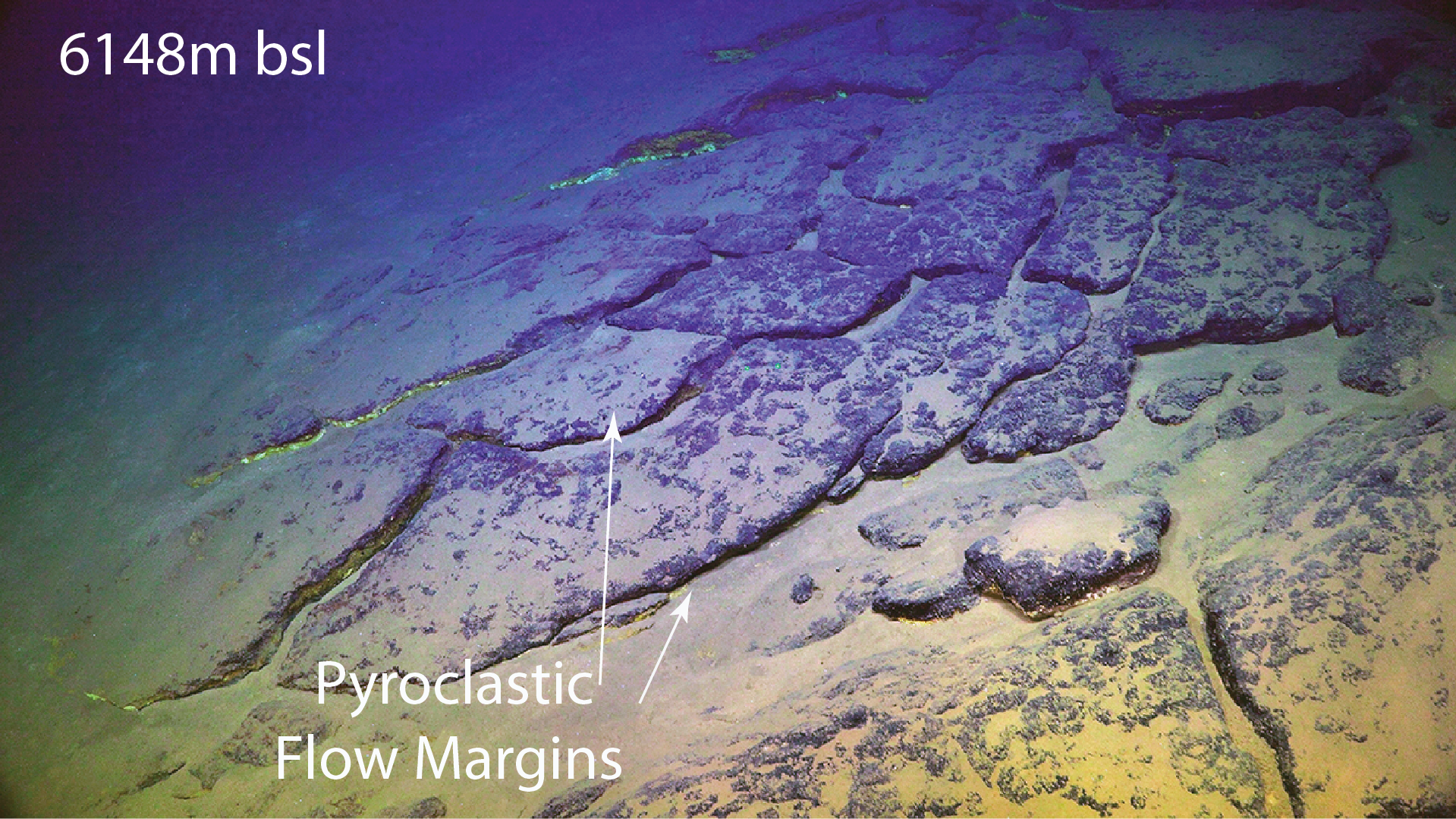
A remotely operated vehicle exploring the Challenger Deep — the deepest point of the Mariana Trench — has documented the deepest pyroclastic volcanic flow ever discovered on Earth, a finding that upends long-held assumptions about where explosive volcanism can occur.
At 6,148 meters (20,170 feet) below sea level, the pressure of 592 atmospheres should suppress the rapid gas expansion that drives explosive eruptions, yet the seafloor bears unmistakable evidence of violent, Pompeii-style pyroclastic flows.
The discovery, reported in Frontiers in Earth Science, suggests that exotic magma chemistry or supercritical fluids may be enabling eruptions in a region previously considered volcanically quiet.
A Surprise in the Abyss
The Challenger Deep sits at the southern end of the Mariana Trench, where the Pacific Plate subducts beneath the Mariana Plate. The trench plunges 10.9 kilometers — deep enough to swallow Mount Everest. Geoscientists have long understood that the forearc region, the broad zone between the trench and the volcanic arc, is typically too cold to generate magma.
Yet in 2014, cameras on the ROV Jason/Medea revealed strange, pancake-like rock formations at three sites along a 100-kilometer stretch of the forearc. Recovered samples contained volcanic glass and textures characteristic of pyroclastic flows — fast-moving currents of hot gas and volcanic matter.
Explain it simply: A pyroclastic flow is a deadly, high-speed avalanche of superheated gas, ash, and rock that races down a volcano's slopes during explosive eruptions. The one that buried Pompeii in A.D. 79 is the most famous example. Finding such deposits at the bottom of the ocean's deepest trench is like discovering a desert in a rainforest — it contradicts the basic rules of where these flows can form.
Pressure Should Prevent Explosions
At 6,000 meters depth, the weight of the overlying water exerts roughly 592 atmospheres of pressure. In typical volcanology, this immense pressure acts like a lid on a pressure cooker: it keeps dissolved water and carbon dioxide trapped in magma, preventing the rapid bubble expansion that drives explosive eruptions. Instead, deep-sea volcanoes usually produce effusive, pillow-lava flows — thick, gooey extrusions that ooze rather than explode.
Explain it simply: Think of a shaken soda bottle. At the surface, opening it releases pressure and the gas bubbles expand violently, spraying soda everywhere. At the bottom of the Mariana Trench, the crushing water pressure acts like an unopenable cap — the gas stays dissolved, and the magma should just seep out gently. The discovery of explosive deposits means something unusual is overriding this physical constraint.
Supercritical Fluids and Strange Magma
Lead author Robert Stern, professor emeritus of geosciences at the University of Texas at Dallas, suggests the eruptions may have been driven by supercritical fluids — a bizarre state of matter that is neither fully gas nor liquid, occurring at extreme temperatures and pressures.
"We just don't know how those magmas will behave at those water depths," said Stephen Self, a volcanologist at UC Berkeley not involved in the study. The presence of fresh volcanic glass, which erodes quickly in seawater, indicates the eruptions are geologically recent — likely thousands, not millions, of years old.
A Crust Pulling Apart in Two Directions
The ROV observations also revealed that the forearc crust is extending in two distinct ways. To the east, mechanical forces are pulling the crust apart. To the west, volcanic eruptions themselves are stretching the crust. This dual mechanism is perplexing.
Sune Nielsen, a geochemist at the University of Lorraine, noted the finding lacks a clear explanation but may signal the birth of a new subduction zone segment. Subduction zones migrate over tens of millions of years, and scientists have never directly observed the initiation of a new one.
Implications for Plate Tectonics
The Challenger Deep forearc already hosts an ocean ridge instead of the organized volcanic arc seen elsewhere along the Mariana Trench. The new magmatic activity could help explain why this trench segment is exceptionally deep.
Stern and colleagues hypothesize that the geochemistry of the recovered rocks will reveal the magma's source and clarify why this region generates melt where thermal models predict none. "This region is really, really unusual for our planet," Nielsen said. "There is quite a bit of, 'What, really? Wait, how is that? OK, yeah, I guess maybe.'"
What Comes Next
The research team is currently dating the samples to constrain the eruption timeline. Geochemical analysis will test whether the magma originated from the mantle wedge, the subducting slab, or an entirely unexpected source. If a new subduction zone is indeed nucleating here, the Challenger Deep offers a rare natural laboratory to study one of plate tectonics' most fundamental and poorly understood processes — how subduction starts.
Was this clear?
library_booksSource
Live Science
23 Nov 2026
- funding model
- commercial media
- owner
- Future plc
Was the source link correct?
topicRelated Articles

Nifty Gateway's Summer 2020 Drops Signal Maturation of Blockchain-Based Art Market

Gemini Engineers Dynamic 3D NFT Badges for Employee Onboarding Using Three.js

Gemini Security Analyst Reveals How AiTM Phishing Bypasses MFA and How Simple Fixes Stop Attackers

Cryptocurrency Wallets Decoded: The Cryptographic Infrastructure Securing Digital Assets

Homo erectus inhabited rainforest environments alongside Denisovans, new research reveals
Mountaintop Sanctuary on Greek Island Reveals Millennia of Ritual Activity

Congress MP Asserts Opposition Unity Against Delimitation Bill, Citing Constitutional Defense
