
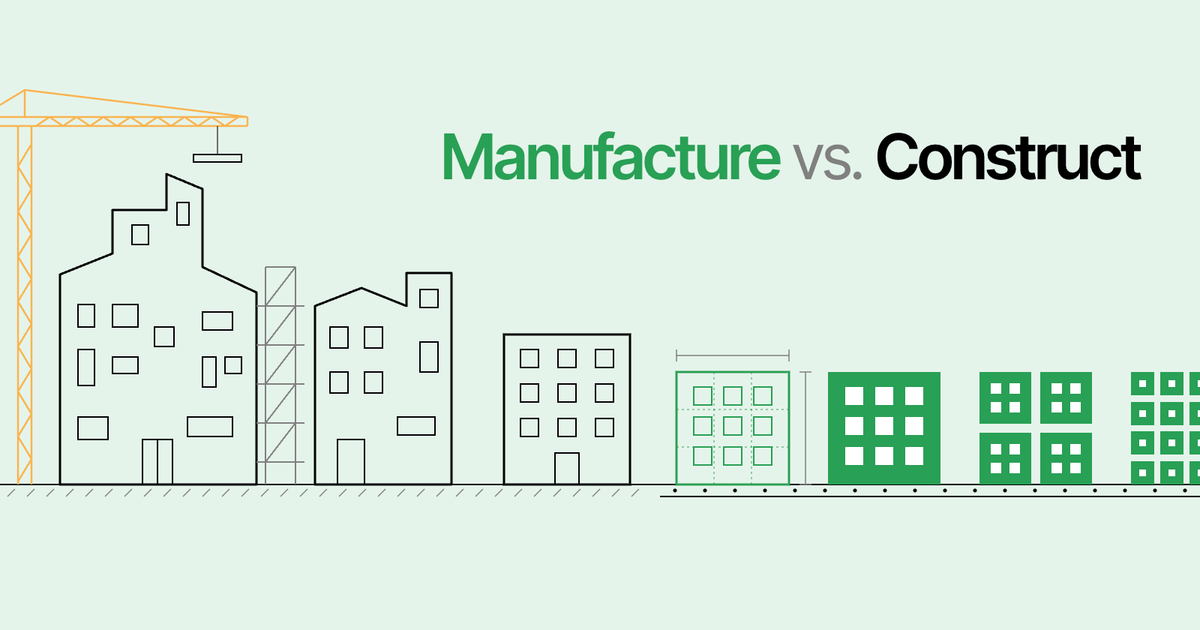
A quiet revolution is underway in how complex infrastructure gets built. Venture capital firm Union Square Ventures (USV) argues that artificial intelligence is finally making it economical to manufacture things — data centers, nuclear reactors, precision machine shops — that have historically been constructed as one-off projects. The shift promises to upend industries where custom engineering, labor shortages, and multi-year timelines have long been the norm.
The distinction between construction and manufacturing is fundamental. Construction creates a unique artifact in place: a bridge, a hospital, a house. Manufacturing produces identical units in controlled conditions, driving down cost with each repetition. Historically, the upfront capital required to design and tool a factory limited manufacturing to high-volume goods.
AI-driven design, generalized robotics, and manufacturing APIs are now collapsing that barrier, allowing low-volume, high-complexity products to be factory-built.
In practical terms, this means treating a data center not as a building project but as a ruggedized box that ships on a truck. It means building a nuclear reactor on an assembly line rather than pouring concrete on a site for a decade. It means acquiring a CNC machine shop and automating it into a repeatable franchise unit that feeds data into a shared learning loop.
The Project-to-Product Playbook
USV's portfolio illustrates three recurring tactics. First, question a constraining input: labor, materials, or place. Rune, a USV-backed company, rethought place and materials for data centers. Instead of constructing a facility, Rune mass-produces modular units — essentially shipping containers packed with server racks and a Starlink link — and drops them where excess power exists.
No concrete pad, no custom build. Radiant applied the same logic to nuclear power, shrinking a 1-megawatt microreactor into a factory-fabricated unit that can be stacked for scale. Both companies challenged the assumption that their respective infrastructures required massive, site-specific construction.
Second, standardize the unit — both the component parts and the system that makes them. Isembard, another USV investment, acquires or partners with CNC factories serving aerospace, space, and defense. Each factory becomes a self-contained, automated unit that contributes to a shared data loop. What one site learns compounds across the fleet.
This mirrors the trajectory of semiconductors: the integrated circuit turned the transistor into a manufactured unit that could be printed by the billion, enabling the exponential cost curves that gave us smartphones.
Third, start small. Small units tighten learning loops. A construction business earns similar margins on every project, growing linearly by adding crews. A product moves down the cost curve with every unit: factory costs spread across more output, and each iteration cuts waste. That compounding dynamic is what venture-scale growth requires.
Why Now? The AI Catalyst
The timing is not coincidental. Generalized vision models now teach robots new tasks without months of custom training. AI-driven computer-aided design makes iteration cheap. Standardized units produce comparable data, so lessons from one deployment compound across a fleet rather than staying with a single crew. In short, AI lowers the upfront cost of manufacturing enough to justify a factory for things that never penciled out before.
Market forces amplify the tailwind. A shortage of skilled trade labor makes site-built projects slower and more expensive. The urgency for more power on the grid — driven by AI data centers and electrification — creates pull for deployable energy infrastructure. Transformers and substations, still custom-engineered with multi-year lead times, have become a bottleneck. Factory-built, standardized grid hardware could unlock deployment speed that site construction cannot match.
The Next Frontiers
USV identifies four domains ripe for the same transition. In biomanufacturing, drug production remains one of the most "constructed" processes in pharma: each molecule demands a bespoke, slow, expensive facility. If drug discovery becomes more engineering than lab science, small-scale, flexible biomanufacturing could follow.
In energy, the grid itself needs productization. Standardized, factory-built substations that ship and drop in would remove a critical constraint on data center and electrification build-out.
In robotics and physical AI, deploying a robot today often resembles a construction project: an integrator custom-builds each installation. As world models generalize across tasks with less training, standardized kits that drop into similar environments — mines, forest fires, first response — become viable.
In private AI, most personal AI hardware targets the high end, requiring expensive compute. A start-small approach might focus on markets where privacy is a requirement, not a preference — law firms, clinics — or on novel chips designed for cheap, high-volume local inference.
The Compounding Logic
The underlying logic is recursive: manufacture the means of manufacturing. When the factory itself becomes a standardized, replicable unit, the learning curve steepens. Data from every deployment feeds the next design iteration. Robots trained on one task generalize to the next. The cost curve bends downward not just for the end product, but for the capacity to produce it.
This is not merely prefabrication reborn. Those waves relied on static designs and manual assembly. Today's wave adds software-defined iteration, fleet-wide data loops, and robots that reprogram themselves. The factory is no longer a fixed asset — it is a product that improves itself.
The implications extend beyond the companies named. Any industry where custom engineering, scarce labor, and long lead times constrain supply is a candidate. The question for founders and investors is not whether the transition will come, but which constrained input — labor, materials, place, or scale — will break first.
Was this clear?
library_booksSource
Union Square Ventures
20 Nov 2026
- funding model
- venture capital (LP/GP fund structure)
- jurisdiction
- USA
- owner
- Union Square Ventures (venture capital, founded by Fred Wilson)
Was the source link correct?
topicRelated Articles

Gemini Launches BitcoinBuzz: A Composite Sentiment Indicator for Bitcoin Markets

Prediction Markets Emerge as Real-Time Forecasting Engines for Finance, Policy, and Sports

Cryptocurrency Mining in 2026: Emerging Strategies for Zero-Cost Operations
Square Expands Subscription Management Tools for Merchants with New Dashboard Controls

Canadian Robotic Exoskeleton Enables First Steps for British Boy with Rare Epilepsy

Congress MP Asserts Opposition Unity Against Delimitation Bill, Citing Constitutional Defense

Love as Resistance: Dalit-Feminist Anthology Reframes Intimacy as Political Defiance Against Caste
