
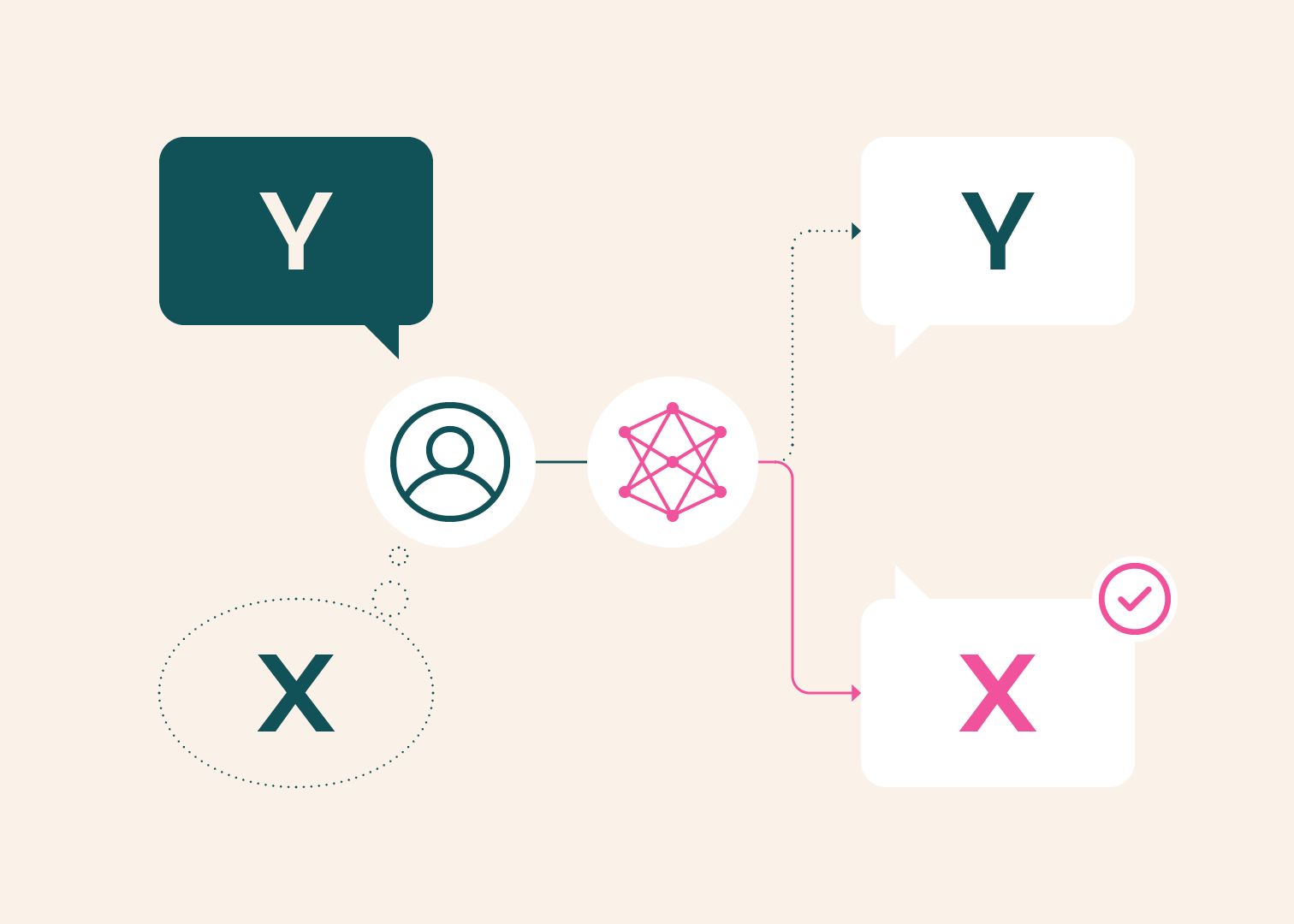
A new benchmark called XYBench has exposed a fundamental limitation in today's most advanced large language models: they frequently fail to recognize when a user's question is built on a mistaken assumption, and even when they do, they rarely restructure their answer to prioritize the user's actual goal over their stated request.
Developed by the Allen Institute for AI (Ai2) in collaboration with researchers from Carnegie Mellon University, NVIDIA, and Johns Hopkins, the benchmark comprises 8,115 real-world questions drawn from programming forums, home-repair guides, and cooking scenarios. It won the Best Resource Paper Award at EMNLP 2026.
The core challenge is known as the XY problem. A person wants to accomplish X — say, frost a cupcake — but assumes approach Y will work, so they ask how to thicken frosting that keeps sliding off. The real issue, however, is that the cupcakes are still warm.
A helpful assistant would recognize the misconception and redirect the user to let the cupcakes cool, rather than simply offering thickening agents. In technical terms, this requires pragmatic reasoning: the ability to infer communicative intent from context, not just parse literal syntax.
Explain it simply: Imagine a driver asking how to make their car go faster by pressing the gas pedal harder, when the real problem is the parking brake is engaged. A good mechanic doesn't just explain pedal technique; they point out the brake. Current AI models mostly act like manuals that only explain pedal technique.
Building a Benchmark for Pragmatic Intelligence
XYBench was constructed from four sources: 1,557 questions from Stack Overflow, 184 from other Stack Exchange sites, 102 manually curated examples, and 6,272 questions generated from WikiHow procedural guides using an earlier model (Claude Sonnet 4.5) to simulate plausible misconceptions.
For each entry, annotators identified the stated request (Y) — what the user explicitly asks — and the intended request (X) — the underlying goal inferable from context. Cases where answering Y would actually solve the problem were discarded.
To evaluate model responses, the researchers defined three distinct metrics:
- Pragmatic Solution: Does the response contain a solution for Y? Does it contain a solution for X? Pragmatic Emphasis: Where does the bulk of the answer's focus lie — on Y, on X, or balanced? Misconception Identification: Does the response actively steer the user toward X while discouraging or avoiding Y?
An automated judge (Claude Sonnet 4.5) classified suggestions within each response. Human reviewers validated the judge on 500 samples, showing high agreement on solution presence (97.5–100%) and misconception identification (84.6–93.3%), with moderate agreement on emphasis (74.2–79.8%).
Models Know the Right Answer But Don't Give It
The evaluation tested five frontier models — Claude Sonnet 4.6, GPT-5, Gemini 3.1 Pro, Qwen3.5-9B, and DeepSeek-V4 Pro — in a single-turn setting. On Stack Overflow questions, every model was more likely to include a solution for the stated request (Y) than for the underlying goal (X). Stated-request solutions appeared in 75–86% of responses; underlying-goal solutions in only 59–71%.
More critically, focus diverged sharply from human behavior. Top human answers focused primarily on the underlying goal (X) in 55% of cases. The best model, GPT-5, did so only 41% of the time. The worst, DeepSeek-V4 Pro and Claude Sonnet 4.6, focused on X just 35% and 36% of the time, respectively. Most model responses either fixated on the user's mistaken approach or split emphasis evenly, diluting the correct guidance.
On misconception identification — actively steering away from Y toward X — the gap widened further. Top human answers achieved a 79% rate. GPT-5 led models at 60%, followed by Qwen3.5-9B (60%), DeepSeek-V4 Pro (55%), Gemini 3.1 Pro (54%), and Claude Sonnet 4.6 (47%).
Explain it simply: The models aren't ignorant; they often mention the right fix (like unclogging a vacuum hose) but bury it under paragraphs about the wrong fix (buying a stronger vacuum). Humans lead with the right fix. Models lead with the user's wrong idea.
The Gap Between Recognition and Generation
A revealing oracle experiment supplied both Y and X explicitly to the models. Sonnet 4.6's rate of including an X-solution rose from 59% to 67%, but its misconception-identification rate fell from 47% to 34%. Making the goal explicit helped models mention it, but hurt their ability to pivot the conversation away from the user's mistaken path. Across all sources, every model still trailed humans on misconception identification even with the oracle.
A separate multiple-choice test laid the problem bare. Given a question and two candidate answers — one focused on Y, one explaining the misconception and addressing X — all six tested models (the five above plus GPT-4.1) picked the goal-focused answer 71–84% of the time. Yet in the generative task, those same models produced goal-focused answers only 35–41% of the time.
Explain it simply: Models can recognize good advice when they see it, but they struggle to write it from scratch. It's the difference between passing a multiple-choice driving test and actually navigating traffic.
Implications for AI Assistant Development
XYBench provides a granular framework for measuring progress. By separating solution inclusion, emphasis, and active redirection, it lets researchers pinpoint whether a training intervention improves detection, prioritization, or both. The benchmark currently covers English-language procedural problems; extending it to other languages, cultural contexts, and open-ended conversational settings remains future work.
The findings underscore a shift needed in AI development: from optimizing for literal instruction-following to optimizing for pragmatic helpfulness.
For now, the message is clear: even the smartest models still need to learn that the best answer to a wrong question is often a gentle correction, not a detailed solution.
Was this clear?
library_booksSource
Allen Institute for AI
13 Nov 2026
- funding model
- philanthropic (non-profit, endowed by Paul Allen estate)
- owner
- Allen Institute for AI (founded by Paul Allen) (Founded by Paul Allen 2014)
Was the source link correct?
topicRelated Articles

Gemini Launches BitcoinBuzz: A Composite Sentiment Indicator for Bitcoin Markets

Prediction Markets Emerge as Real-Time Forecasting Engines for Finance, Policy, and Sports

Cryptocurrency Mining in 2026: Emerging Strategies for Zero-Cost Operations
Square Expands Subscription Management Tools for Merchants with New Dashboard Controls

Canadian Robotic Exoskeleton Enables First Steps for British Boy with Rare Epilepsy

Congress MP Asserts Opposition Unity Against Delimitation Bill, Citing Constitutional Defense

Love as Resistance: Dalit-Feminist Anthology Reframes Intimacy as Political Defiance Against Caste
