
Polygon has unveiled the Open Money Stack, a wallet infrastructure designed to bring institutional-grade security to everyday cryptocurrency payments. The system addresses a growing crisis in digital asset security: TRM Labs recorded 207 crypto hacks in the first half of 2026, with infrastructure compromises accounting for just 15% of incidents but 76% of losses.
Meanwhile, centralized cloud outages — such as the AWS disruption in October 2025 that halted services including Coinbase and MetaMask — have exposed the fragility of relying on single points of failure.
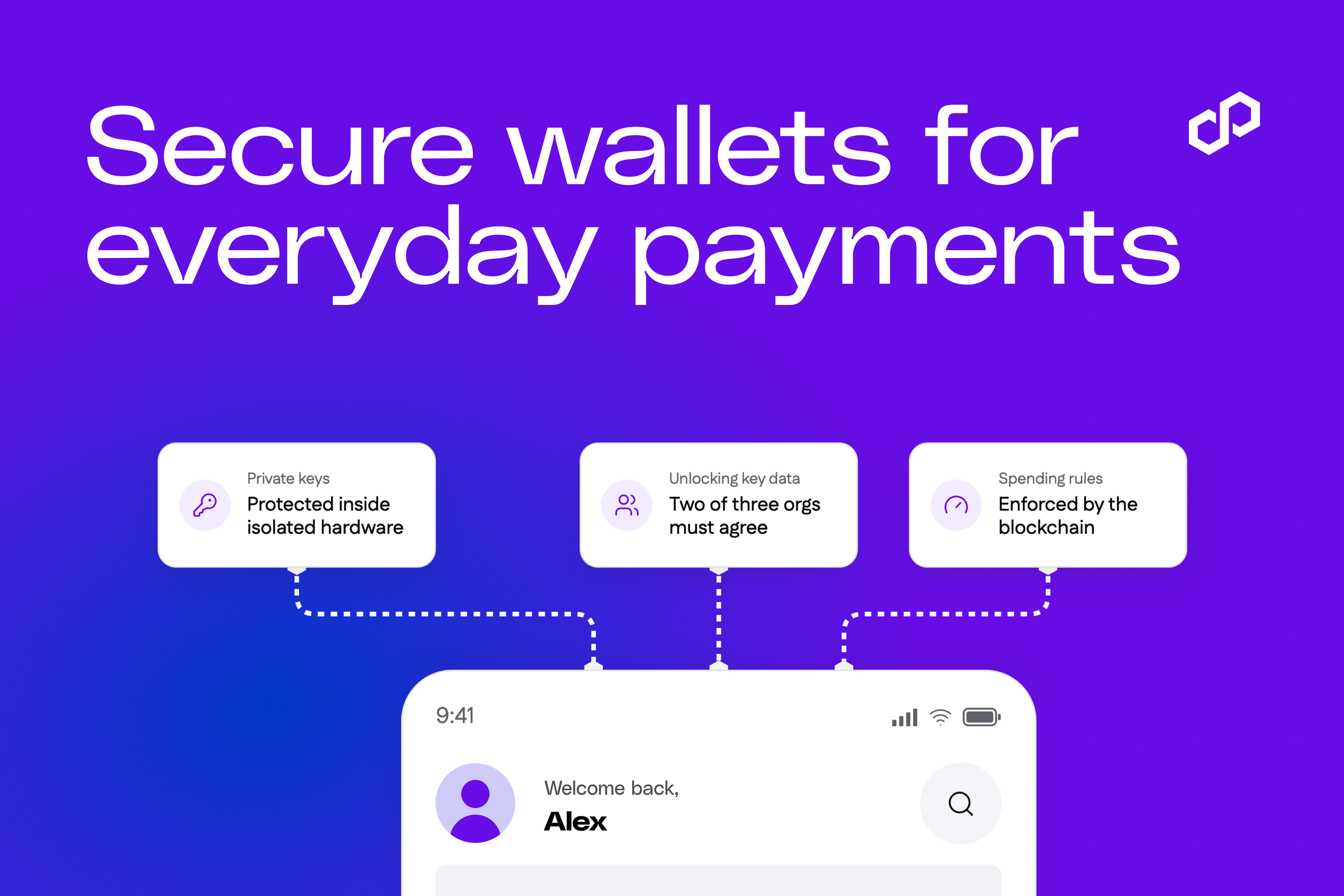
The Open Money Stack responds with a three-layer architecture that keeps private keys in isolated hardware, distributes access authority across three independent organizations, and enforces spending rules directly on the blockchain.
The Security Architecture
Hardware Isolation with AWS Nitro Enclaves
Private keys — the cryptographic secrets that authorize transactions — are generated and used exclusively inside AWS Nitro Enclaves. These are hardened, isolated computing environments physically separated from the host server's operating system and hypervisor. Even Polygon's own server administrators cannot inspect the enclave's memory or extract the keys.
Explain it simply: Think of a private key like the master key to a vault. Normally, that key sits on a server where a hacker who breaches the system — or a rogue administrator — could copy it. An enclave is a vault within a vault: a sealed, tamper-resistant box inside the server that no one, not even the people who own the server, can open or peek into. The key never leaves this box; transactions are signed inside it.
The Key Council
Hardware isolation alone is not unique — many wallet providers use secure enclaves. Polygon's differentiator is the "key council": unlocking the protected key data requires agreement from at least two of three independent organizations — Polygon, Quantstamp, and CoinCover. No single entity, including Polygon itself, can access the keys unilaterally.
Explain it simply: Imagine a safety deposit box that needs two out of three different bank managers to turn their keys simultaneously before it opens. Even if one manager is compromised or goes rogue, the box stays locked. This "2-of-3" multisignature governance means the wallet provider cannot unilaterally move user funds, and a breach at any single organization does not expose the keys.
Smart Sessions
Blockchain-Enforced Limits
Everyday payments often involve recurring actions — subscriptions, automated purchases, or AI agents acting on a user's behalf. The Open Money Stack introduces Smart Sessions, which let users approve specific actions, set a spending cap, and define an expiry time. These rules are encoded in the wallet's smart contract and enforced by the blockchain itself.
Explain it simply: Instead of handing your credit card to a subscription service and hoping they only charge the agreed amount, you give them a special, limited-purpose token.
AI Agents and Automated Payments
This architecture enables new payment flows. A user can authorize an AI agent to pay for a specific service within a defined budget and time window. The agent operates within the permission but never receives the user's private key. The spending boundaries are built into the wallet contract, so they do not depend on the application remembering to enforce them.
Independent Verification and Transaction Screening
Audits and Cryptographic Proofs
The wallet contracts have undergone independent audits by Quantstamp, ConsenSys Diligence, and Code4rena. Beyond static audits, every response from the wallet service includes a cryptographic proof of the exact code that produced it. This allows businesses and users to verify at runtime that the executing code matches the audited version.
Guard
Businesses can add Guard, an optional transaction screening service. Guard checks transactions against configurable policies — blocking interactions with unknown contracts, flagging large transfers, or screening against known risky addresses. This adds a compliance layer without altering the core non-custodial security model.
Recovery Without Platform Dependence
24-Word Phrase with Safety Delay
A wallet for everyday use must offer a recovery path that does not rely on the provider's continued operation. Users can link multiple sign-in methods and, for non-custodial wallets on Ethereum and Polygon, recover access using a standard 24-word recovery phrase through a tool that operates without Polygon's involvement.
Explain it simply: If Polygon disappears — goes offline, shuts down, or blocks your account — you can still get your money back. You use your 24-word backup phrase (the same kind used by hardware wallets like Ledger) with an open-source recovery tool. There's a 30-day safety delay to prevent attackers who steal your phrase from immediately draining the wallet, giving you time to notice and react. The underlying blockchain must be live, but Polygon's servers do not need to be.
Integration into Payment Flows
The Open Money Stack connects these secure wallets to fiat on-ramps, off-ramps, and routing through a single integration. Apps can sponsor network fees or allow users to pay fees in stablecoins, eliminating the need to acquire a native gas token before making a payment. The payment experience remains familiar — users sign in, approve a Smart Session once, and the app handles subsequent transactions within the agreed boundaries.
Polygon positions the Open Money Stack as infrastructure for a new class of payment applications: non-custodial, programmable, and resilient to both cyberattacks and operational failures. By combining hardware isolation, distributed key governance, on-chain enforcement, and provider-independent recovery, it aims to close the gap between the security expectations of traditional finance and the realities of blockchain-based payments.
Was this clear?
library_booksSource
Polygon
25 Nov 2026
- funding model
- blockchain protocol (MATIC token ecosystem)
- jurisdiction
- Switzerland/India
- owner
- Polygon Labs / Polygon Foundation (Switzerland)
Was the source link correct?
topicRelated Articles

Gemini Launches BitcoinBuzz: A Composite Sentiment Indicator for Bitcoin Markets

Prediction Markets Emerge as Real-Time Forecasting Engines for Finance, Policy, and Sports

Cryptocurrency Mining in 2026: Emerging Strategies for Zero-Cost Operations
Square Expands Subscription Management Tools for Merchants with New Dashboard Controls

Canadian Robotic Exoskeleton Enables First Steps for British Boy with Rare Epilepsy

Scientists Define Red Lines for Autonomous AI Agents Amid Growing Capability Concerns
Ai2's MolmoBot Achieves Zero-Shot Robot Manipulation Trained Entirely in Simulation
