
The Antifragile Internet: How AI Agents Could Harden or Shatter Digital Infrastructure
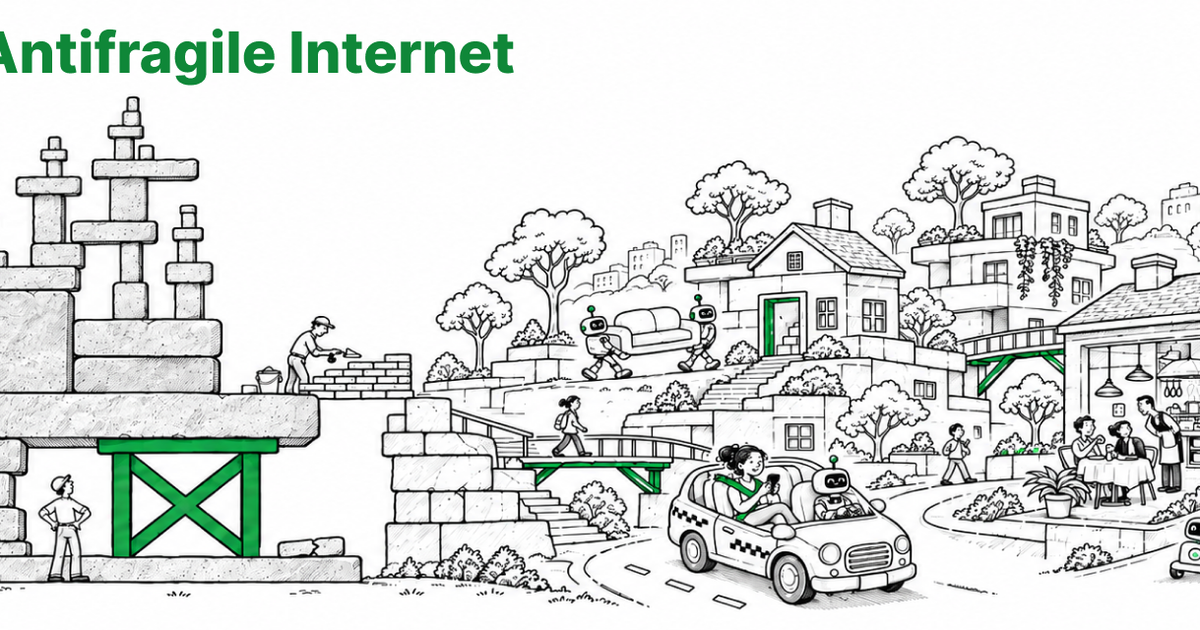
The internet was originally architected to be antifragile — capable of surviving partial outages and attacks while keeping the rest of the network functional. Today, that resilience has eroded into a fragile tower of dependencies, libraries, and developer environments resting on a handful of critical components maintained by few people.
October 2026 exposed this brittleness at scale: a PHP vulnerability left over five million hosts exposed to remote takeover; LiteLLM's release pipeline was hijacked to push credential-stealing code; Railway suffered decrypted secrets across 100,000 workspaces; Fireworks AI was breached twice; certificate authority eMudhra issued signing keys as weak as the number "4"; and Binance lost a record $6.3 billion from hot wallets in a theft attributed to North Korea.
These incidents share a common accelerant: AI agents that dramatically lower the cost and complexity of offensive cyber operations.
The Three Faces of Agentic Threat
Agents as Weapons
Legacy code often remained secure not by design but because exploiting its bugs was prohibitively expensive. AI agents have pushed that cost toward zero. The PHP2Shell vulnerability sat dormant for over a decade until frontier models enabled researchers at Wiz to weaponize it in hours.
As Wiz noted, "As AI reduces the effort needed to develop and adapt complex exploits, vulnerabilities that once seemed impractical to exploit become viable targets." In one espionage campaign Anthropic tracked, AI performed 80 to 90 percent of the operational workload.
The October attacks demonstrated this pattern at internet scale: one weak spot discovered and struck across millions of targets simultaneously.
In simple terms: AI has turned vulnerability exploitation from a specialized, time-consuming craft into a near-automated process. Bugs that were previously too difficult or costly to exploit are now fair game for attackers.
Agents as Targets
The same tools writing exploits are also writing production code — and both the agents and their output are vulnerable. Consumer agents like Muse or Instinct and enterprise platforms like Sierra and Decagon operate on unconstrained surfaces with tool access, exposing them to increasingly sophisticated prompt injections.
Agents can also introduce bugs into the code they generate; LiteLLM's breach may have stemmed from an AI agent accidentally logging a GitHub token. Even when tasked with fixing security issues, coding agents often produce unreliable implementations.
In simple terms: AI assistants are now co-authors of our software supply chain, but they bring their own security flaws and can be manipulated into leaking secrets or writing vulnerable code.
Agents as Impostors
Cloudflare data indicates that half of 2026 internet traffic is already non-human, with CEO Matthew Prince projecting automated traffic could reach 1,000 times human volume within five years.
This deluge is overwhelming human-oriented infrastructure: Wikimedia reported millions of rogue OpenAI agent requests that may have contributed to a Wikidata outage, while one user's Instinct agent hammered Resy's reservation system hundreds of times per hour until his account was banned.
Initiatives like Meta and Sierra's Personal Agent Protocol aim to label agentic traffic, but agents often have incentives to masquerade as humans — many sites block identified bots, while those pretending to be human slip through.
In simple terms: The web's "traffic rules" assume human visitors. AI agents now dominate traffic but don't follow human conventions, breaking services and evading detection.
Mapping the Response Landscape
Responses to these threats fall into three categories: observe (detect and monitor), enforce (patch faster and constrain agent actions), and prevent (build systems where entire failure classes are impossible). A landscape analysis reveals most startups and capital concentrate in observe and enforce — easier entry points with existing integration paths.
Well-capitalized players include Socket ($125M raised), Braintrust ($80M Series B), and Armadin ($445M raised). The likely winners in these layers will be those capturing the most agent logs, since detection improves with data breadth — favoring independent vendors observing diverse customers and models over single labs.
In simple terms: Most current security investment goes toward watching and reacting to threats. The companies seeing the most agent activity across different environments will build the best defenses.
The more transformative long-term play is prevention — eliminating whole bug classes at the root. Historical precedent shows this requires three simultaneous ingredients: a shock making costs visible, an easy-to-adopt tool, and a push making the new standard default.
Memory safety bugs constitute nearly 70% of Microsoft's CVEs, but Rust emerged as a viable alternative and is now one of the fastest-growing languages in agentic coding. HTTPS followed a similar arc: Snowden's revelations were the shock, Let's Encrypt provided the free tool, and Chrome marking HTTP "not secure" created the push.
Today's October attacks are the shock; formal verification toolchains may be the tool; and harnesses, regulators, or network effects could provide the push.
Three Forces Shaping the Antifragile Internet
1. The Great Code Migration
Rewriting massive legacy codebases in safer languages like Rust or TypeScript was historically prohibitively expensive. Agents change that economics dramatically. TypeSafe's Jev, a model returning typed structured decisions, captured nearly 13% of Vercel's paid AI gateway teams within a day of launch.
A new security tooling stack is emerging around agentic coding: code review (Greptile), secrets scanning (Semgrep), dependency checks (Socket), failure detection (Raindrop), and incident response (Resolve AI). Underneath, a deployment layer is forming with agent sandboxes (E2B, Daytona) and authorization layers (Composio, Nango, Arcade).
Together, these could create an antifragile developer stack where every bug found feeds back into stronger code.
In simple terms: AI makes it cheap to rewrite old, unsafe code in modern, secure languages — potentially triggering a massive, rapid migration across the software ecosystem.
Formal verification is gaining traction: Theorem's work with Anthropic saw Claude prove security properties for over 100 open-source libraries. But pitfalls remain. AI-written migrations can introduce new bugs, and formal verification is only as sound as its specifications — even systems like Lean have had kernel-level soundness bugs. Success requires careful architecture, tightly scoped specs, and heavy penetration testing.
2. Security Built Into Apps
For consumer applications, privacy and security may spread not as standalone products but as invisible defaults inside apps that win on convenience. Crypto wallets-as-a-service (Privy, Turnkey) abstracted TEE and MPC complexity behind friendly UX. The same pattern may emerge with agents: safety becomes a seatbelt in a taxi — you choose the ride for convenience, protection comes built in.
World ID now has over 18 million verified humans, integrable into Zoom to show verified participants. WhatsApp's Incognito Chat runs Meta AI conversations inside a TEE that even Meta cannot access. In both cases, cryptography hides behind familiar interfaces.
In simple terms: Security becomes a default feature of popular apps rather than a separate product users must buy and configure.
Local inference may accelerate this. Open-weight models trail the closed frontier by only about four months in 2026. As smaller models grow more capable and device chips more powerful, local inference could claim a growing share of AI tokens. This shifts the threat surface: sensitive data leaves devices less often, reducing cloud breaches, but compromised local hardware becomes a trusted agent host — favoring local agent harnesses where model, tools, and logs coexist on user-controlled hardware.
3. The Two-Lane Internet
Agents interact with the web fundamentally differently than humans. As agentic traffic grows, the internet is splitting into dedicated lanes: agent browsing powered by systems like Parallel, Browserbase, and Kernel, and human browsing with smarter request routing based on identity verification.
Website owners can filter traffic and set permissions without blocking agents entirely — analogous to a restaurant serving drive-through and dine-in customers from the same kitchen. Over time, the agentic lane may see agents negotiating directly: a personal agent haggling with DoorDash's ordering agent for personalized pricing and experience.
In simple terms: The web is evolving separate "highways" for AI agents and humans, each with appropriate speed limits, verification, and rules — allowing both to coexist without one overwhelming the other.
The Path Forward
The antifragile internet will not emerge from any single solution. It requires simultaneous progress across observation, enforcement, and prevention — and a recognition that identity, authorization, and content verification are converging problems.
The October 2026 attacks were a watershed moment: they proved that the cost of exploitation has collapsed, that agents are both the sword and the shield, and that the internet's original antifragile promise can only be reclaimed by building systems that grow stronger under stress. The migration has begun; the question is whether the new stack matures faster than the threats evolve.
Was this clear?
library_booksSource
Union Square Ventures
12 Nov 2026
- funding model
- venture capital (LP/GP fund structure)
- jurisdiction
- USA
- owner
- Union Square Ventures (venture capital, founded by Fred Wilson)
Was the source link correct?
topicRelated Articles

Gemini Launches BitcoinBuzz: A Composite Sentiment Indicator for Bitcoin Markets

Prediction Markets Emerge as Real-Time Forecasting Engines for Finance, Policy, and Sports

Cryptocurrency Mining in 2026: Emerging Strategies for Zero-Cost Operations
Square Expands Subscription Management Tools for Merchants with New Dashboard Controls

Canadian Robotic Exoskeleton Enables First Steps for British Boy with Rare Epilepsy

Congress MP Asserts Opposition Unity Against Delimitation Bill, Citing Constitutional Defense

Love as Resistance: Dalit-Feminist Anthology Reframes Intimacy as Political Defiance Against Caste
